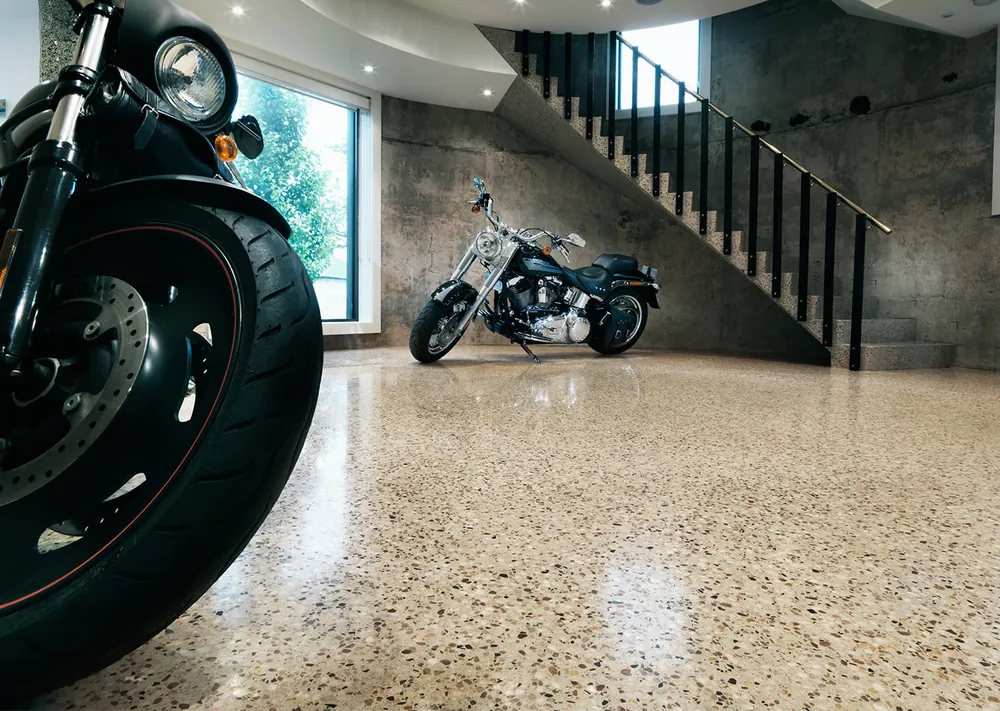
Worth it is arithmetic, not opinion. Take the install price, divide it by the number of years the floor actually survives, and compare that to what you would otherwise spend. In St. Petersburg a moisture-tested, diamond-ground floor gives 10 to 20 years. A roll-on kit over a slab nobody measured often gives one. Same garage, same product aisle — the entire difference sits in the prep.
Most articles on this question argue about resin brands. Brands barely move the number. What moves it is the condition of the concrete you already own, and whether anyone bothered to measure it before the first pail was opened.
That matters more here than in most places, because a lot of our concrete is old. The 2024 American Community Survey puts 67.7% of St. Petersburg housing units in buildings that predate 1980. If you are in Historic Kenwood, Crescent Lake, Euclid–St. Paul's or Jungle Terrace, the slab under your car has been in the ground for more than four decades. That is not a reason to skip a coating. It is a reason to measure before anyone quotes one.
What follows: the case for, the case against, a four-way comparison, and the three situations where we would tell you to keep your money. If you would rather just get a number for your own floor, call (727) 292-1860.
Cost Per Year, Not Cost Per Job
Do the division and the argument mostly settles itself. A professionally installed flake or polyaspartic system — moisture reading, full diamond grind, crack repair, UV-stable topcoat — commonly returns 10 to 20 years of service. Spread the price across that and you are paying less per year than almost any other finished surface you could put on the same concrete. You also stop paying the quiet cost of bare slab: dust on every shelf, oil that never fully comes out, and a garage nobody wants to use for anything but parking.
Run the same division on the failure case and it inverts hard. A big-box kit over a slab that was never ground and never tested can lift inside a year. Nothing about that is exotic. Epoxy holds concrete mechanically, and a trowel-smooth or previously sealed surface gives it very little to grip. Add moisture moving up out of the slab and the coating is being pushed off from underneath while it is still curing.
So the one-line answer: a good epoxy floor is one of the better-value things you can do to a garage in this city, and a bad one is money set on fire. Everything below is about telling the two apart before you sign.
What You Actually Get
Done properly, epoxy earns its reputation. Here is what the money buys.
Ten to Twenty Years, Not One or Two
A real epoxy or polyaspartic system is measured in mils and bonded into an opened, ground surface. Garage paint is a film sitting on top. The distinction announces itself the first hot afternoon a car parks on it with soft tires: hot-tire pickup peels paint and leaves a bonded system alone. Ten to twenty years is the normal residential range, and that number is the whole reason the per-year math works.
A Room Instead of a Slab
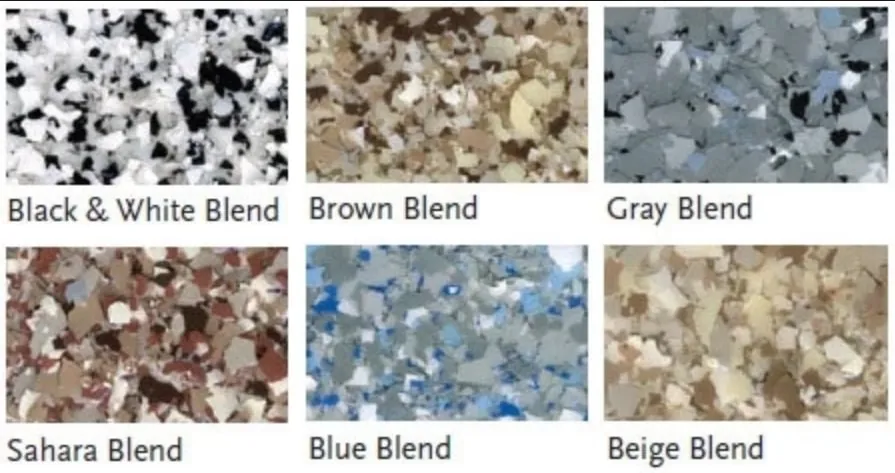
Bare concrete reads as unfinished no matter how clean it is. Flake blends hide marks and give the eye something to land on; metallic finishes pour and swirl into something closer to stone. In a Snell Isle or Historic Old Northeast garage that doubles as a workshop, a gym, or the door the family actually walks through, that visual jump is most of the reason people call us in the first place.
Nothing to Scrub, Nowhere for Water to Sit
An epoxy floor is seamless and non-porous. No grout lines, no pores, nowhere for a spill to soak in. That is a convenience most of the year and occasionally rather more than that. Shore Acres has taken water into homes four times in four years, and when a floor gets wet the gap between a seamless coating and carpet, laminate or grouted tile is the gap between squeegee-and-dry and a demolition bag. We are not selling a coating as flood protection — nothing you put on a slab is that. But a floor that cleans up is worth owning in a city where cleaning up happens.
Traction Is a Spec, Not a Gamble
Gloss is slick when it is wet. That is physics and we do not argue with it. It is also optional. A flake or quartz broadcast gives the surface texture; a slip additive in the topcoat does the same for a smooth finish. Between June and September, when roughly two thirds of our annual rain falls, a car comes into the garage wet several times a week. We spec traction on garage floors here by default and treat a glass-smooth garage as the exception somebody has to ask for.
It Lands in the Sensible Middle
For a garage or a large open room, flake usually installs for less than porcelain tile and lands near high-end polished concrete, with no grout to maintain and no reseal cycle to remember. Per-finish numbers are in our St. Petersburg epoxy flooring cost guide.
Want the Math Run on Your Own Garage?
Tell us the size, the age of the slab, and what you use the space for. We will read the concrete and give you a real number, free — including when the honest answer is "not yet."
What You Are Actually Giving Up
No floor is free of drawbacks, and pretending otherwise is how people end up disappointed. These are the real ones.
The Prep Is the Product
This is the big one. If the concrete is not ground open, if cracks are not chased and filled, if moisture is never measured, then premium resin will still fail. The coating is not the hard part. That is why two quotes for "an epoxy floor" can describe completely different jobs, and why the cheap one is so reliably the one that comes back.
The Weather Owns the Schedule
Here is the part almost nobody mentions, and it runs opposite to what you would guess. Relative humidity in St. Petersburg sits near 88% at 7 a.m. and falls to roughly 57% by late afternoon. Manufacturer data sheets cap application at about 85% RH, above which the resin can blush and the bond suffers. So the binding constraint on an install day is the morning — not the afternoon thunderstorm everyone worries about. A crew that starts grinding at seven and starts coating at eight is coating into air the product sheet told them to wait out.
The same sheets ask for a surface at least 5°F above the dew point through prep, application and cure — the rule every manufacturer's data sheet repeats. And the sea breezes off the Gulf and off the Atlantic meet somewhere over the peninsula on a typical afternoon; some days that collision line sets up directly over Pinellas and a working window closes inside an hour. None of that makes an epoxy floor a bad idea. It does mean the schedule belongs to the weather, and a crew that will not move a start time is a crew worth questioning.
DIY Odds Are Worse Here Than on the Box
Plenty of climates forgive a weekend kit. This one is stingier. The instructions assume a dry, ground slab and air inside the product's stated range, and a Saturday-morning start in St. Petersburg frequently satisfies neither. If you are set on doing it yourself, at least borrow the two measurements a professional takes — a calcium chloride test to ASTM F1869 or in-situ relative humidity probes to ASTM F2170 — before you open anything. Our St. Petersburg moisture failure guide explains what those numbers mean once you have them.
You Lose the Space for a Few Days
A garage install typically runs one to three days depending on repairs and system, then foot traffic before vehicles. Polyaspartic topcoats shorten the tail meaningfully, which is a genuine local advantage: it lets a crew finish inside one good-weather window instead of gambling on the next one. Either way the space is out of service for a stretch. Plan where the cars go, not just what the floor looks like.
Chips Happen and Patches Show
Drop something heavy enough and the floor loses. A spot repair is straightforward but rarely invisible against a floor that has had a few years of daylight on it, and metallic finishes are hardest to match because the pattern is unique to the pour. Most homeowners never touch this. It is still fair to know you are buying a finished surface, not a self-healing one.
Day One Costs More Than Paint
There is no way around this. The grind, the crack repair, the moisture-mitigation primer when the slab calls for one, and a decent topcoat are all real line items, and paint has none of them. The return arrives over years, not at checkout. If today's budget only covers the cheapest coating on the shelf, the useful question is not "can I afford epoxy" but "will this cheaper thing still be here in eighteen months."
Against Tile, Polish and Paint
The fair test is not epoxy in isolation. It is epoxy next to the other three things you could reasonably do with the same slab.
| Option | Typical Cost | Durability | Maintenance | Lifespan |
|---|---|---|---|---|
| Epoxy / Polyaspartic | $5–$14 / sq ft | High — resists tires, impact, chemicals | Low — seamless, mop & rinse | 10–20 years |
| Porcelain Tile | Often higher installed | High, but grout & edges chip | Higher — grout lines to clean | 10–20+ years |
| Polished Concrete | Comparable to flake | High, but shows stains | Low–moderate; periodic resealing | 10–20 years |
| Paint / DIY Kit | Lowest upfront | Low — peels under tires & moisture | Frequent recoating | 1–3 years here |
Tile and polished concrete are legitimate choices; they simply carry different chores. Tile brings grout to clean and edges to chip. Polish shows stains and wants resealing. Paint is the cheapest today and, on a garage slab that takes wet tires most weeks of the rainy season, almost always the most expensive over a decade. Epoxy sits in the middle: premium-tier durability, seamless, with nothing recurring on the calendar. If you want the two coating chemistries compared directly, our epoxy vs. polyaspartic breakdown does exactly that.
Five Situations Where We Say Go
These are the cases where we would tell a neighbor to spend the money.
- You are staying put. Every extra year you keep the floor drives the per-year number down. Owners who plan to be in the house a decade get the best of this deal by a wide margin.
- The garage is a second room. A workshop, a home gym, a place to stage boat gear — a seamless, slip-rated garage floor earns its keep every time you use the space, not just when you look at it.
- The dusting and staining have worn you down. Bare slab sheds fines onto everything and drinks oil permanently. A coating ends both on the day it cures.
- You want an interior space to look designed. A metallic or flake floor turns a residential interior into a finished room for less than most flooring that would do the same job.
- You are prepared to do it properly. Grind, measure, mitigate if needed, UV-stable topcoat. Commit to that sequence and the floor pays you back. Skip any step and none of the rest matters.
To see how a size, finish and color come together before you commit, our Floor Studio builds the look and shows a real St. Petersburg price range in about a minute.
Three Where We Say Wait
We would rather lose the job than sell a floor you regret. Hold off if any of this describes you.
- The house lists in three weeks and you want it tidy. A finished garage helps a home show, but it does not come back dollar for dollar at closing, and a full system installed days before the photos rarely pencils out. Clean it, sell it, and let the next owner decide.
- You are eyeing a cheap kit for a slab nobody has measured. This is the classic local mistake. Spending a little to get a floor that fails is worse than spending nothing, because now the next installer has to remove your coating before starting. Either do it correctly or wait until you can.
- The concrete has an unresolved problem. Active cracking, movement, a known moisture source nobody has traced. A coating does not fix a slab; it hides it briefly and then reports it. Fix the concrete first, coat it second.
In all three cases the objection is not epoxy. It is the distance between what a lasting floor needs and what the situation currently allows. Close that distance and the answer flips back.
Why the Answer Is Sharper Here Than Elsewhere
St. Petersburg holds the world record for consecutive sunny days — 768 of them, 9 February 1967 to 17 March 1969 — and the Sunshine City nickname stuck for a reason. Sunshine is lovely, and it is also ultraviolet, and ultraviolet is what ambers a topcoat that was never rated for it. Any stretch of floor that sees daylight through an open garage door wants a UV-stable finish. Skipping that is one of the two ways a floor ages badly here.
The other way is moisture, and not in the dramatic direction people imagine. It is the ordinary morning air: near 88% at seven, only dropping under the product's ceiling by mid-morning, with two thirds of the year's rain packed into June through September and a sea-breeze line that occasionally parks over the peninsula and ends an afternoon early. A crew that works to the dew-point rule and the RH ceiling gets a floor that lasts two decades. A crew that works to the calendar gets one that fails — same slab, same pail, different result.
So the verdict: comfortably worth it when the install respects the air it is going into, and a poor buy when it does not. The deciding variable is almost never the resin. It is whether anyone measured. That is why every estimate we write opens with a moisture reading and a straight opinion about your concrete, including the times that opinion is "not yet."
For the full mechanism — how slab moisture actually lifts a coating, and the test that catches it first — read our guide to why epoxy floors fail here. It is the most useful thing to understand before you spend a dollar.
Questions From the Driveway
Is epoxy flooring a good investment?
Judged per year of service, yes for most St. Petersburg homeowners, provided the install includes a moisture reading, a full diamond grind and a UV-stable topcoat. A floor built that way gives 10 to 20 years. The same money spent on a kit poured over an untested slab can give you one, which is not an investment at all.
Does epoxy flooring increase home value?
It makes a garage or interior read as finished and cared for, which a buyer registers in the first few seconds of a walkthrough. Treat it as a feature that helps a space show well, not as a line item that returns a fixed number at closing.
Is epoxy worth it over just painting the garage floor?
Almost always. Paint is a thin film sitting on top of the concrete. Epoxy is bonded into a surface that has been opened by a grinder. Hot tires lift the first and leave the second alone. Paint wins on day one and loses over any period longer than a couple of years.
Is epoxy flooring slippery when wet?
A glass-smooth gloss floor is, in the same way polished tile is. Texture solves it: a flake or quartz broadcast, or a slip additive mixed into the topcoat. With roughly two thirds of our rain falling between June and September, we spec traction on St. Petersburg garages as the default rather than the upsell.
How long does an epoxy floor last?
Ten to twenty years for a professionally installed flake or polyaspartic floor in a St. Petersburg garage. Prep and topcoat decide it, not the brand on the pail. A DIY kit over an unprepped slab is frequently a one-to-three-year floor. We go further into this in our guide to how long an epoxy floor lasts here.
Get a Number for Your Own Slab
Everything above is general. Your floor is not. The only way to know whether the arithmetic works on your concrete is for somebody to read it in person: moisture, cracks, previous coatings, and how the door and the afternoon sun sit relative to the space. That is what our estimate is, and it costs nothing.
Call (727) 292-1860 or request a quote online. We work across St. Petersburg and the rest of Pinellas — Clearwater, Largo, Pinellas Park, Seminole, Gulfport, Dunedin, Palm Harbor, East Lake, Tarpon Springs, and the beach communities out to Treasure Island and Tierra Verde.
Related Articles
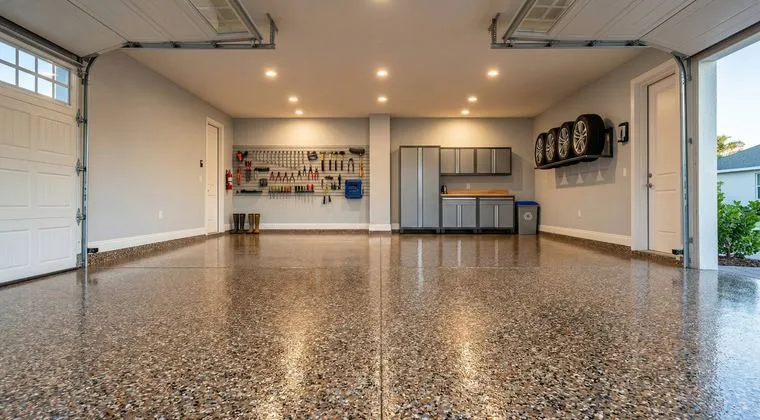
How Much Does Epoxy Flooring Cost in St. Petersburg? (2026 Guide)
Real 2026 St. Petersburg prices by finish plus a typical 2-car garage total.
Epoxy vs. Polyaspartic in St. Petersburg
Which coating actually wins in St. Petersburg heat and humidity.
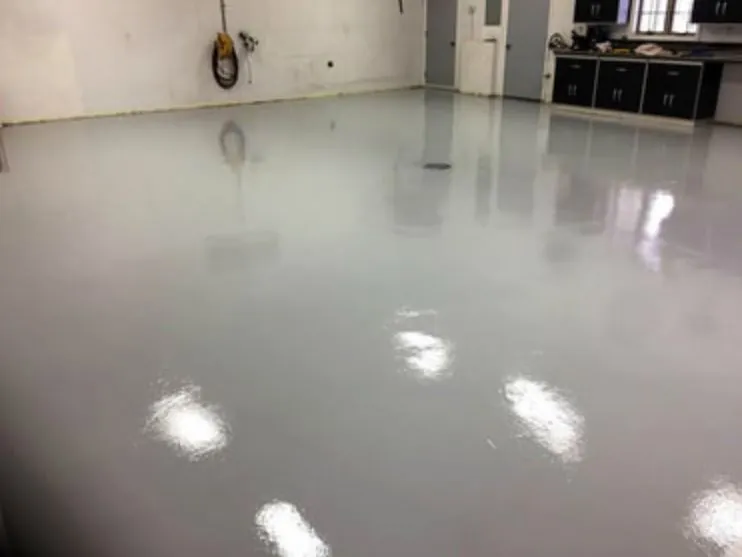
How Long Does an Epoxy Floor Last in St. Petersburg?
Realistic lifespans and what makes a St. Petersburg floor last.