Polished Concrete in St. Petersburg — Nothing on Top to Fail
Diamond-ground, densified, mechanically polished concrete for St. Petersburg — Grand Central District storefronts, Warehouse Arts District studios, the shop floors along 49th Street North, and the light-industrial blocks out by Carillon Parkway. We refine the concrete already under your feet instead of bonding a film on top of it, so there is nothing to blister, chalk at the edges, or let go in sheets. The shine is the slab itself.
What Polishing Actually Is — and Why It Suits Buildings Here
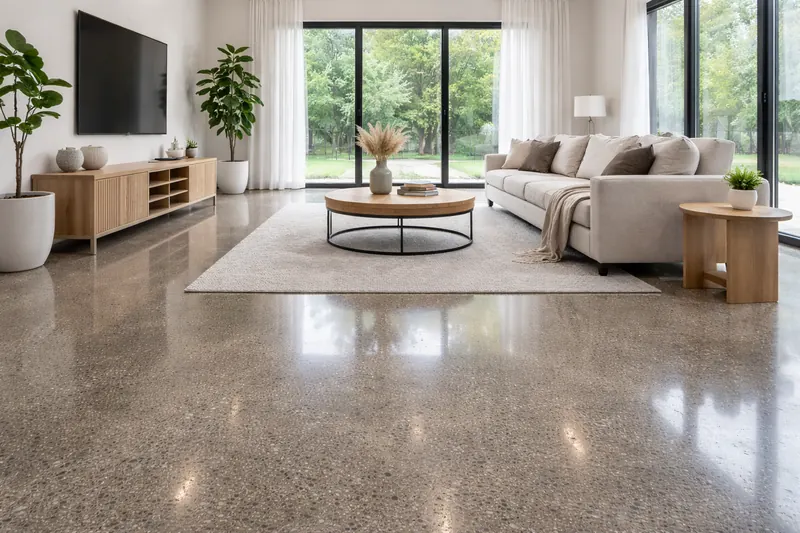
Polishing is machine work, not paint work. Nothing is added to the floor except a densifier that soaks in and disappears. We open the surface with coarse metal-bond diamonds, spread a penetrating lithium silicate that hardens the concrete from the inside, then step through finer and finer resin grits until the surface starts to throw a reflection. What you walk out on is the same slab you walked in on, only tighter, harder and brighter. Because there is no separate layer, there is nothing that can blister, chalk at the edges, or let go in sheets.
That matters here, because in St. Petersburg a coating decision is really a moisture decision. Concrete moves water vapor whether or not anyone measures it, and there are two ways to measure it: ASTM F1869, the calcium-chloride test, and ASTM F2170, an in-situ probe that reads relative humidity inside the slab itself. When those numbers come back high, a film-forming system becomes the risky option and a polish becomes the safe one, because a polished floor has no membrane for vapor to collect beneath. We test before we quote either way — and we will tell you when polishing is the wrong answer too.
The buildings that suit it sit right across the peninsula. Light industrial up around Carillon Parkway wants a hard, dust-free slab a pallet jack cannot chew up. Restaurants and shops in the Grand Central District and downtown want the reflective, faintly mottled look without a recoat booked every few years. Studios in the Warehouse Arts District and the older commercial blocks along 49th Street North often already own the right slab — it is just buried under tile mastic or a failed sealer, and taking that off is most of the job. Houses count too: 67.7% of St. Petersburg housing units predate 1980, and a mid-century slab under old carpet is frequently the best candidate on the street.
If the space genuinely needs a built-up coated system instead, the industrial epoxy flooring and commercial epoxy flooring pages cover those builds. To put the numbers side by side, the St. Petersburg flooring cost guide breaks down what each system runs per square foot.
Get a Free Quote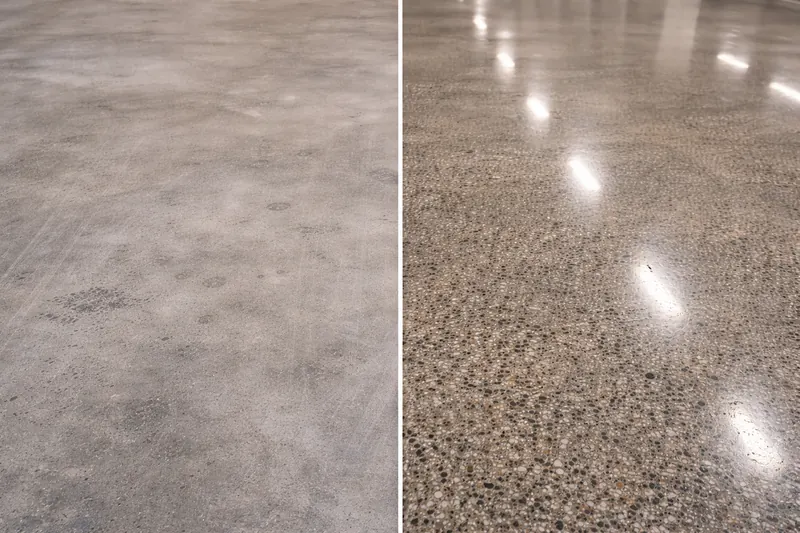
Five Mechanical Passes and One Chemical One
Before the first diamond touches the floor we test the slab for moisture and check how hard it cured, because a soft or damp slab tops out at a lower sheen than a dense one. Better to hear that on day one than on day three.
Slab & Moisture Read
~45 minWe walk the whole floor, map cracks, joints, spalls and old adhesive, scratch the surface to gauge how hard the concrete cured, and run a moisture test — ASTM F1869 or F2170 — so the sheen we promise is one your slab can actually hold. Joints get filled and defects patched before grinding starts. Book a free slab read.
Coarse Grinding
4–8 hrsMetal-bond diamond tooling takes off high spots, tile mastic, carpet glue, curing compound, and whatever sealer a previous tenant rolled down before it started flaking. This is the pass that decides how the finished floor will look: it sets the flatness and how much aggregate gets exposed, anywhere from a tight cream finish to full salt-and-pepper.
Densifier Application
1–2 hrsA lithium-silicate densifier goes down on the freshly opened surface and reacts with free lime in the concrete, hardening it from within. A denser slab takes a higher polish, sheds far less dust, and stands up better to the grit that gets walked in off a loading dock or a beach parking lot.
Fine Polishing
6–10 hrsResin-bond diamonds step up through 400, 800, 1500 and 3000 grit, and we stop where you chose to stop — a low satin that hides traffic in a Pinellas Park shop, or a deep gloss for a downtown showroom that wants the ceiling to show up in the floor. Every step closes the surface a little further.
Guard / Sealer
1–2 hrsA thin penetrating guard goes on last for stain resistance. It absorbs rather than sitting on top, so the slab keeps breathing. Timing matters more than people expect: relative humidity in St. Petersburg sits near 88% at 7 a.m. and only slides toward the high 50s late in the afternoon, while manufacturer data sheets cap application around 85% and repeat the same rule about keeping the surface at least 5 degrees above the dew point. So the guard goes down in the drier half of the day, not the wet half.
The Read Costs Nothing.
Book a walk-through anywhere from Tierra Verde to Tarpon Springs and we will tell you on site how high a polish your concrete will take — and what it costs to get there.
What a Polished Slab Buys a St. Petersburg Business
Six reasons shop, warehouse and storefront owners across Pinellas pick grinding over a coating.
Brighter
More Light Off the Same Fixtures
A ground and polished surface bounces light instead of swallowing it, so a room reads brighter without adding a single lamp. In a high-bay unit in the Pinellas Park light-industrial belt or a showroom on 49th Street North that can mean leaving a row of fixtures switched off — and the floor still reads deliberate to anyone walking in.
Zero
No Wax, No Strip, No Recoat
Nothing to strip, nothing to wax, no recoat to schedule around your hours. A dust mop most days and a damp mop now and then is the entire maintenance program — which is what a kitchen that never closes or a stockroom that never stops needs from a floor.
None
No Bond Line, No Delamination
Peeling, chipping and delamination are failures of a coating's grip on the concrete, not of the concrete. Take the coating out of the equation and they go with it. The most common failure mode in floor coatings simply has nowhere to happen on a polished slab.
Breathable
Vapor Has Somewhere to Go
Concrete moves water vapor whether anyone wants it to or not — that is the whole reason ASTM F1869 and F2170 exist. A polished floor puts nothing over the top for that vapor to gather beneath, so a slab that reads too wet to take a film can still take a polish and a penetrating guard.
20+ yrs
Wear Happens to Concrete, Not to a Film
Traffic abrades the top of whatever it runs across. On a coated floor that is a film a few mils thick; on a polished floor it is hardened concrete. Pallet jacks, forklifts, dragged crates and grit off the lot all take far longer to show, which is why cost per year lands below a coating you have to keep renewing.
Sealed
The Slab Stops Making Dust
Bare concrete sheds a fine grey powder every time something rolls over it. Densifier reacts inside the pores and shuts that down, which keeps packaging, inventory and stock cleaner in a warehouse — and means one less thing settling on the tools in a workshop.
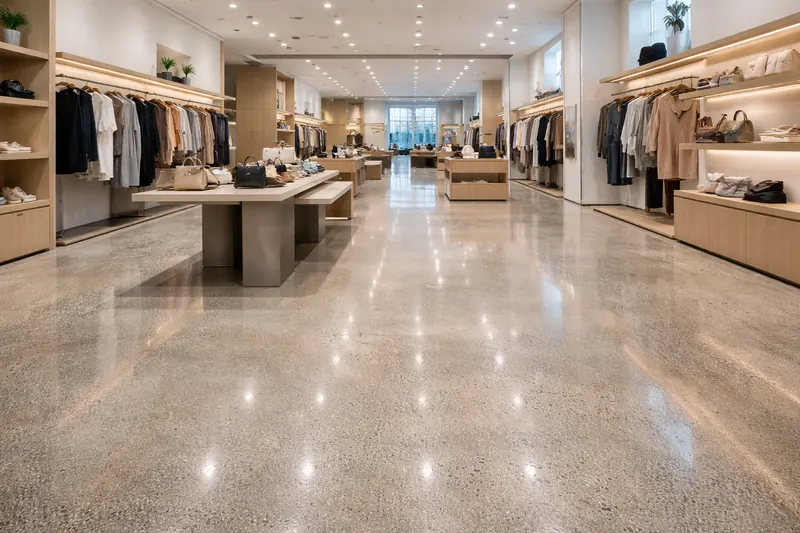
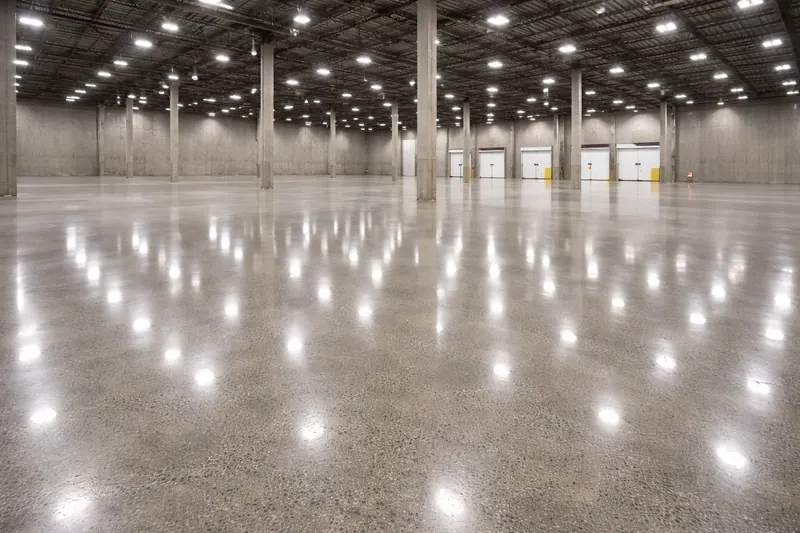
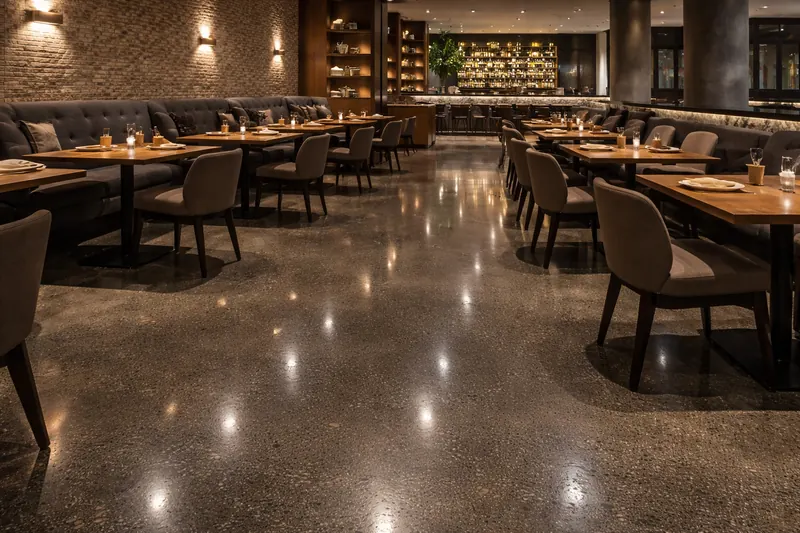
Polished Concrete Across Pinellas
Showroom, warehouse, retail and residential slabs polished in St. Petersburg and around the county.
Rated 5.0★ — St. Petersburg Reviews
Real reviews from real St. Petersburg customers.
"The work done to my garage was terrific - the technicians were punctual and the price was good. I'm really happy with how it turned out."
"I am really impressed with the quality of their work and their customer service. I see a lot of other companies in the same field, but none of them compare to them."
"Good people, clean work, fast delivery."
Polished Concrete FAQs — St. Petersburg
What St. Petersburg owners ask before they book a grind.
Epoxy adds; polishing subtracts. An epoxy floor is a polymer coating bonded on top of your slab, and it lives or dies by that bond. Polishing removes the top skin of the slab, hardens what is left with a penetrating densifier, and refines it through finer diamonds until it reflects — no coating, no bond line, nothing to delaminate. Epoxy wins when you need chemical resistance, a specific color, or a seamless cove base. Polishing wins on large floors that want a natural look and the least maintenance.
Most polished concrete in St. Petersburg lands between $3 and $8 per square foot. Where you fall in that range depends on how much crack and joint repair the slab needs, how much aggregate you want exposed, and how far up the grit sequence you want to go — a satin finish costs less than a mirror. It is usually cheaper than a full epoxy build-up over the same floor. Call (727) 292-1860 and we will price it after reading the slab, not before.
Usually, yes. Age is rarely the problem. Most slabs that have sat under a building for thirty or forty years polish well once the tile mastic, carpet glue or flaking sealer comes off — and that removal is the first grinding pass anyway. There is plenty of concrete that old here: 67.7% of St. Petersburg housing units were built before 1980. What does rule a slab out is a thin topping over the structural pour, heavy previous patching, or a surface someone has already ground past its aggregate. Call (727) 292-1860 and one visit will tell us which you have.
There is no coating to reach the end of its life, so the floor lasts as long as the slab does — twenty years and well past it with routine cleaning. What changes is sheen, not integrity. Traffic lanes dull first, and a dulled lane can be re-burnished in place, usually overnight, instead of shutting the space down for a re-installation.
Dry, it grips about as well as tile or terrazzo. The gloss comes from flatness, not from a slick film, so polishing does not make concrete more slippery than it already was. Wet is the real question, and in a city that takes roughly two-thirds of its rain between June and September it is worth asking. For entryways, restrooms and kitchen lines we add a traction additive to the guard or drop the sheen where the water actually lands, and keep the mirror where the floor stays dry.
Design your floor in 60 seconds.
Pick your size, finish, and color. See a real preview and your St. Petersburg price range before you call.
Open Floor Studio →