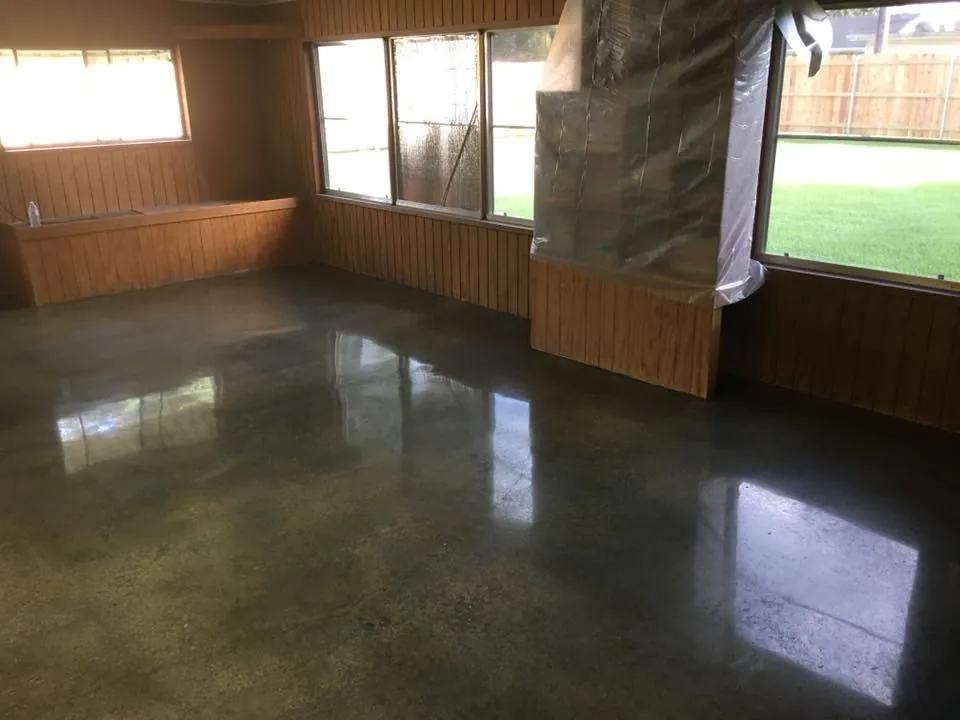
Here is the short version, before the reasoning. Residential coating work in St. Petersburg runs $4 to $14 per square foot installed. On a standard 400-square-foot two-car garage that is about $1,600 to $2,800 in solid color and $2,000 to $3,600 in flake — the finish most people end up choosing.
Those are our published numbers, and they are the same ones our Floor Studio configurator runs on. You can put in your own room, pick a finish and see the range in under a minute, without a form, a callback or a salesperson in your driveway. We would rather you arrive at the conversation already knowing what things cost.
What follows is where those figures come from: what each finish is and why it prices the way it does, what a real two-car garage totals once prep is counted, the four local factors that actually move your number, and how to read two estimates that are far apart. If you would rather skip to a number for your specific slab, call (727) 292-1860. Otherwise, start here.
Per Square Foot, by Finish
“Epoxy” covers four fairly different floors, and which one you pick sets most of your price. The table is the whole answer; the paragraphs under it explain what you are buying at each step.
| Finish | Cost Per Sq Ft | Best For |
|---|---|---|
| Solid Color | $4–$7 | Utility bays, storage rooms, workshops |
| Flake / Chip | $5–$9 | Most home garages — hides marks, adds grip |
| Metallic | $9–$14 | Interiors and showrooms where the floor is the feature |
| Quartz | $10–$14 | Hard use, wet areas, slip resistance |
Solid Color Epoxy ($4–$7 per sq ft)
One color, high gloss, nothing decorative. It sweeps clean, it takes a hose, and it makes a dim garage noticeably brighter because a light solid reflects rather than absorbs. This is the right floor for a utility bay, a storage room, or a workshop where the point is a sealed surface rather than a look. The cheapest national figures you will find online assume an acid etch and a thin roll-on kit; ours assume a full diamond grind, which is why a solid-color job here usually settles around $5 to $6 a foot rather than $4.
Flake / Chip Epoxy ($5–$9 per sq ft)
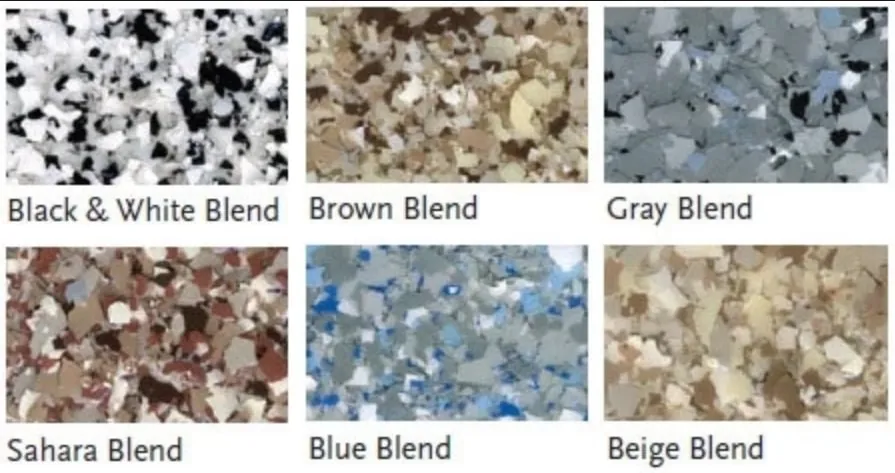
Vinyl chips are broadcast into the wet base coat, then the whole thing is sealed. You get texture underfoot, a multicolor surface that hides hot-tire marks and old patches, and grip on a floor that would otherwise be slick when wet — which matters in a garage where a car comes in dripping through most of the summer. Blends run from quiet grays to high-contrast. Where you land inside the $5 to $9 band is mostly a question of coverage and topcoat: a partial broadcast under a standard clear sits near the bottom, a full-refusal broadcast under a UV-stable polyaspartic sits at the top, around $7 to $9. That upper build is what we put in most St. Petersburg garages, for reasons the cost-driver section gets into.
Metallic Epoxy ($9–$14 per sq ft)
Reflective pigment is suspended in clear resin and moved by hand while it is still open, so the pattern is worked into the floor rather than printed on it. No two come out the same. We install these in home gyms, interior living space, and small retail and studio floors around the Grand Central District, and the price tracks the design more than the square footage: one pigment and a simple marble effect sits near $9, a layered multi-pigment pour with a defined pattern approaches $14. Most of that spread is hours of skilled labor, not material.
Quartz Epoxy ($10–$14 per sq ft)
Colored quartz granules go into the resin instead of vinyl chips, building a thicker, harder, deliberately textured floor. It is the finish you specify when the surface has to take impact, chemicals and a pressure washer on a schedule — commercial kitchens, clinics, locker rooms, wash bays. It also makes sense residentially in a wet room or a working shop. Quartz is nearly always priced after a walkthrough rather than off a list, because thickness and slip profile get specified to the use.
Want the Number for Your Own Garage?
Tell us the room and what you use it for. You get a straight range and a recommendation, at no cost and with nobody following up twice a week.
The 2-Car Garage Number
Per-foot rates are abstract, so here is the arithmetic done for you. We size a standard two-car bay at 400 square feet, which is the same figure the Floor Studio uses. Multiply the band for your finish by 400 and you have the range — there is no markup hiding between the two pages.
| 2-Car Garage (400 sq ft) | Range |
|---|---|
| Solid color | $1,600–$2,800 |
| Flake (the usual choice) | $2,000–$3,600 |
| Metallic | $3,600–$5,600 |
| Quartz | $4,000–$5,600 |
Those totals cover the work itself: diamond-grind prep, crack and spall repair, the moisture reading, the base coat, the decorative layer and a UV-stable topcoat. Two adjustments to make against your own garage. First, size — plenty of St. Petersburg bays are deeper than 400 square feet, and a 500-square-foot garage scales the whole range up by about a quarter. Second, the slab. If the moisture reading comes back high, a mitigation primer adds $1.50 to $3.00 a square foot, which on a 400-foot floor is another $600 to $1,200, and the reading itself is $200 to $400.
We would rather show you that add-on as a separate line than fold it invisibly into a higher headline price. It is conditional. Plenty of slabs here test fine and never need it, and you should not be paying an insurance premium on every quote for a problem your garage may not have. That is the entire reason the reading happens before the number rather than after the deposit.
Four Things That Move Your Number
Two identical-looking garages a block apart can quote differently, and it is almost never the resin. Four variables account for most of the spread.
1. How old the slab is, and what has happened to it
This is the biggest one, and it is fair to expect a contractor to look before pricing. Per the 2024 American Community Survey, 67.7 percent of housing units in St. Petersburg were built before 1980. A slab of that vintage has usually had a life: hairline and structural cracks, spalled edges near the door, an old sealer or a failed coating that has to come off before anything new goes on, oil that soaked in rather than sat on top. Grinding is priced in machine hours, so a rough slab genuinely costs more to prepare than a clean one. A newer garage out toward the Gateway area or East Lake often prices at the bottom of its band for exactly this reason.
2. Whether the moisture reading calls for a primer
Concrete holds water, and water moving up through a slab is what lifts a coating off from behind. The reading — an ASTM F2170 probe seated in the slab, or an ASTM F1869 calcium chloride dish on the surface — costs $200 to $400 and settles it. Comes back high, a mitigation primer at $1.50 to $3.00 a square foot goes down first. Comes back fine, you are not billed for a primer you do not need. Both outcomes are common here. What is not acceptable is a number written without the reading at all.
3. The topcoat, and the hours it has to cure in
Humidity in St. Petersburg runs near 88 percent at 7 a.m. and falls to roughly 57 percent by late afternoon, while most epoxy data sheets cap application around 85 percent relative humidity. That is a genuine constraint on when the wet work can happen, and it is why these floors get a fast-curing, UV-stable polyaspartic on top instead of a slow bare epoxy. It costs more per foot than a basic clear. It also fits inside the part of the day that is actually within spec, and it does not amber the way an unprotected epoxy does behind an open bay door in July.
4. Where the building sits, and what happens in it
A closed residential garage in Crescent Heights and an open bay a couple of blocks off the water in St. Pete Beach are not the same specification. Salt exposure works on edges and thresholds, and a floor left open to the weather gets a thicker, more chemically resistant build. Use matters the same way: a workshop in the Warehouse Arts District or a light-industrial unit off 49th Street North takes dropped tools, solvent and forklift wheels, so it gets specified up. So does access — a floor a grinder has to be carried down to costs more than one a truck can back up to.
None of that is an argument for spending more. It is an argument for knowing which of the four applies to your garage, because three of them may not. If you want the long version of the moisture question specifically, our companion piece on why epoxy floors fail in St. Petersburg works through the readings and the cure window in detail.
Picking Your Finish
Start from how the room gets used, not from the price column. The answer usually falls out in one sentence.
- You want it sealed and clean. Solid color, $4 to $7. A storage bay, a laundry room, the side of the garage the lawn equipment lives on.
- You park cars on it. Flake, $5 to $9. Chips hide tire marks and old patching, the texture gives you grip when a wet car comes in, and it is the finish most St. Petersburg homeowners land on.
- People are going to look at it. Metallic, $9 to $14. A home gym, a converted interior room, a small retail or studio floor where the floor is part of the design.
- It is going to get worked on. Quartz, $10 to $14. Wet rooms, kitchens, clinics, wash bays — anywhere slip resistance and chemical resistance are the requirement rather than a bonus.
If you cannot decide, the honest default for a house garage here is a full flake broadcast under a polyaspartic clear. It is not the cheapest line on the table and it is not the most expensive one, and it is what we install most often.
Reading a Quote Line by Line
A per-foot rate tells you almost nothing on its own, because two contractors can quote the same rate for very different amounts of work. Five things belong in writing on any estimate you are asked to sign.
- The slab reading. Named method, and taken before the price rather than after. If it is absent from the document, ask why it is absent from the job.
- How the concrete gets opened. The word you want is grinding, with a stated finish profile. An acid wash is not surface preparation; it is a rinse.
- Cracks and spalls, itemized. Routed, filled, and named on the quote. This is the line most often left off and then discovered on install day.
- Every layer of the system. Primer if required, base coat, decorative layer, topcoat — with the topcoat's product type stated. One thick coat of something is not a system.
- The total, and what is excluded. Compare project totals, not rates, and read what has been carved out of scope to get the rate down.
When one bid comes in far under the others, something has been removed rather than discounted. Usually it is the reading, the grinding, or the topcoat — and those three are precisely the parts you cannot see once the floor is finished and cannot add later without starting over.
Frequently Asked Questions
How much does epoxy flooring cost in St. Petersburg?
Between $4 and $14 per square foot installed, depending on the finish. On a standard 400-square-foot two-car garage that works out to roughly $1,600 to $2,800 in solid color and $2,000 to $3,600 in flake, covering diamond-grind prep, crack repair, the slab moisture reading and a UV-stable polyaspartic topcoat. Those are the same figures our Floor Studio prices from, so you can build the estimate yourself before anyone calls you.
How much does it cost to epoxy a 2-car garage in St. Petersburg?
About $2,000 to $3,600 for flake on a standard 400-square-foot bay, and $3,600 to $5,600 for a metallic floor in the same space. A deeper 500-square-foot garage scales up by roughly a quarter. If the slab reads high for moisture, a mitigation primer adds $1.50 to $3.00 per square foot on top — which is exactly why the reading is taken before the quote. Prep steps and flake styles are laid out on our St. Petersburg garage floor coating page.
Why does a St. Petersburg epoxy floor cost what it does?
Prep and topcoat, mostly. Diamond grinding, crack repair and a moisture reading are not optional on older concrete, and 67.7 percent of housing units in this city were built before 1980 according to the 2024 American Community Survey. The topcoat is a UV-stable polyaspartic rather than a bare epoxy because humidity here sits near 88 percent at 7 a.m. while most epoxy data sheets cap application around 85 percent — a fast-curing topcoat is what fits inside the usable part of the day.
What is the cheapest epoxy floor option?
Solid color, at $4 to $7 per square foot — about $1,600 to $2,800 on a 400-square-foot garage. It is a clean, glossy, one-color surface that sweeps easily, and it is the sensible pick for a utility bay, a storage room or a workshop where nobody is trying to impress anyone.
Is epoxy flooring cheaper than tile or polished concrete?
For a garage or any large open floor, a flake system usually installs for less than porcelain tile and sits close to high-end polished concrete. The practical difference is the grout: a coated floor is seamless, so there is no grout line to scrub, stain or re-seal.
Does an epoxy floor add value to a St. Petersburg home?
We will not quote you a resale percentage, because nobody can honestly produce one for a garage floor. What is fair to say is that a coated garage reads as finished and maintained rather than unfinished, it photographs well in a listing, and it is one of the less expensive things you can do to a room that size.
Getting a Number for Your Own Slab
Everything above is a range, and a range is only useful until you have an actual floor in front of you. Two ways to close the gap. Build it yourself in the Floor Studio — pick the room, the size and the finish, and it prices from the same table you just read. Or have Duane come and look at the concrete, take the reading, and tell you which of the four cost drivers actually apply to your garage.
Either way there is no charge and no obligation. Call (727) 292-1860 or request a quote online. We work St. Petersburg, Clearwater, Largo, Pinellas Park, Dunedin, Palm Harbor, East Lake, Tarpon Springs and the rest of Pinellas County.