Residential Epoxy Flooring in St. Petersburg — For Slabs With Some Years On Them
Most of the concrete we coat in this city is older than the furniture standing on it: 67.7% of St. Petersburg housing units were built before 1980. Decades of settling, patching and hairline cracking is not a reason to skip a coating — it is a reason to read the slab before you start one. Seamless flake, metallic and quartz floors for lanais, Florida rooms, kitchens and garages, from Historic Roser Park to Bahama Shores.
Old Concrete, Wet Autumns, Bright Rooms — The Three We Design Around
Age. Two out of every three housing units in this city — 67.7%, per the 2024 American Community Survey — went up before 1980. Around Historic Kenwood, Historic Old Northeast, Euclid–St. Paul's and Crescent Heights that means slabs carrying four and five decades of settlement cracks, patches and old adhesive. Water. The St. Petersburg tide gauge, which holds the longest record on Tampa Bay going back to 1947, logged its highest water level ever during Hurricane Helene on 26 September 2024 — 6.31 feet above mean higher high water. Albert Whitted took 18.54 inches of rain in a single calendar day during Milton, the wettest day in a record that starts in 1998. Shore Acres has flooded four times in four years. Light. This is the city that ran 768 consecutive sunny days between February 1967 and March 1969 and still holds the world record for it. A Florida room here takes that daylight all day long, and a clear coat that isn't UV-stable goes the color of weak tea in it.
All three point the same direction, which is why we treat the moisture reading as the job itself rather than paperwork. Every slab gets an ASTM F1869 calcium-chloride test or an ASTM F2170 in-situ RH probe before a lid comes off, because concrete still releasing vapor will push a coating straight back off itself, and because after standing water the only honest way to know a floor is ready is to measure it. High reading, we bond a vapor-barrier primer. Very high reading, we tell you to give it more drying time and come back — Duane would rather lose the week than lay a floor that fails.
Past that, the finish is genuinely a choice: a poured metallic that moves like water under the light, a flake blend that swallows every grain of sand that comes in on a flip-flop, a quartz broadcast where you want grip, or one flat clean color. All of it seals under a UV-stable polyaspartic, which is the layer that matters most in rooms with that much daylight in them. The hardest-used space in the house is usually the attached garage, and it has its own garage epoxy page; the numbers for a whole project sit in the St. Petersburg epoxy cost guide.
Get a Free Quote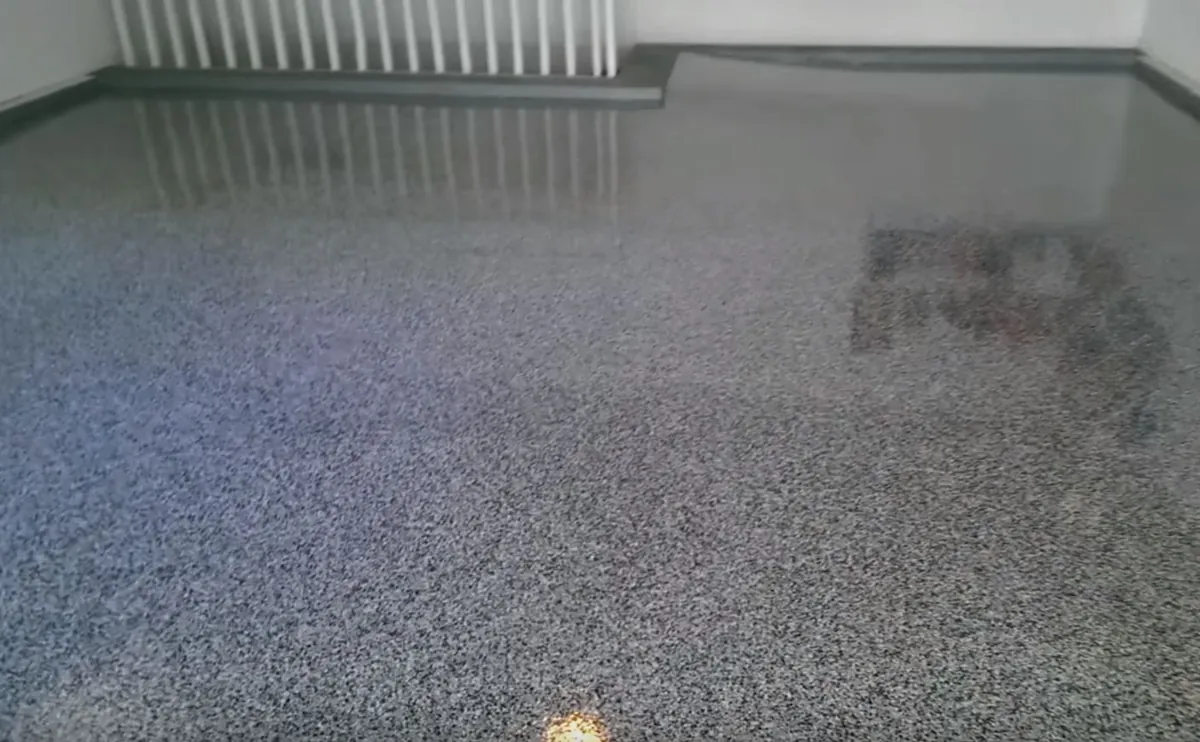
Room by Room, and Why
The four spaces St. Petersburg homeowners actually call us about.
The screened lanai & pool deck
The lanai is the room this city actually lives in, and it is the one nobody finishes. Flake under polyaspartic puts real texture underfoot for wet feet coming off the pool and the rain that blows through the screen in July, and unlike bare concrete or dark pavers it doesn't turn into a griddle by two in the afternoon.
The Florida room & sunroom
These catch more direct sun than anything else under the roof, which is precisely where a bargain clear coat goes amber. UV-stable topcoat, always — and we tend to steer people to a metallic or a pale flake, because a reflective floor throws the daylight back into the room instead of holding it as heat.
The attached garage
In Tanglewood, Pasadena, Snell Isle and out through Seminole and Gulfport, the garage is doing three jobs at once — workshop, gym, and wherever the bikes and beach chairs end up. Coating it stops the slab dusting onto everything, resists hot-tire pickup, and means chain oil and spilled fertiliser wipe up instead of staying forever. Details on our garage floor coating page.
Kitchens, entries & laundry rooms
In the older houses around Historic Roser Park, Crescent Lake and Jungle Terrace, the grout lines are where the trouble lives — they hold damp and grow mildew you can scrub at forever without winning. A seamless floor has no lines. Spilled coffee, tracked sand, a washer hose that let go overnight: all of it just wipes.
Six Reasons People Here Pick It Over Tile
What St. Petersburg homeowners tell us actually made the decision.
Seamless
One Sheet, No Lines
Tile is a grid of small waterproof things separated by porous ones. Epoxy is a single continuous membrane, poured wall to wall, with nothing anywhere in it for water, sand or spores to lodge in. That is the whole argument, and in this climate it is a strong one.
40+
Forty-Plus Ways to Finish It
Metallic swirl, flake blend, quartz broadcast, or one flat color. Two practical notes from doing this here: a mid-tone flake hides the fine sand every driveway in this city sends indoors, and a light metallic makes a small Florida room read a size bigger than it is.
Slip-Rated
Safe Wet, Kind to Paws
A fine aggregate broadcast into the topcoat puts grip exactly where things get wet — pool deck, lanai, the strip inside the door during a downpour. Indoors the same system stays smooth: dog claws don't score it, and an accident comes up with plain water instead of soaking somewhere you can't reach.
5 min
The Entire Maintenance Routine
A dust mop, and every few weeks a damp one. That is the list. No wax, no annual sealer, no branded bottle you have to keep reordering. Sand off the drive, rain blown in through the screen, clippings off the mower — a cured epoxy surface doesn't take a mark from any of it.
Resale
The Detail Buyers Remember
Nobody photographs a lanai floor, but everyone walks on one. A finished, glossy, seamless surface where the last four houses had stained concrete and mildewed grout lines is the kind of thing that turns into a second showing.
See full pricing guide →20+ yrs
Comes Through a Storm Season
Laminate swells, carpet holds the damp, and tile lets go of a slab that has taken on water. Over concrete we have actually metered, epoxy runs 20+ years — and if water ever does get inside, a non-porous floor is something you squeegee, dry and disinfect rather than something you tear out and skip.
How humidity affects durability →How a Floor Gets Installed With You Still Living There
Five steps. Two are about your concrete, one is about the weather on the day, and all of them happen around your furniture and your family. Here is the whole thing, start to finish.
Free Consultation
~45 minOur installer or a crew lead walks the rooms with you, looks for the tells an old slab gives up — chalky efflorescence, dark patches, a crack that has moved — talks through what each finish will and won't do in that particular light, and leaves a written quote with nothing hidden in it. Book the visit free.
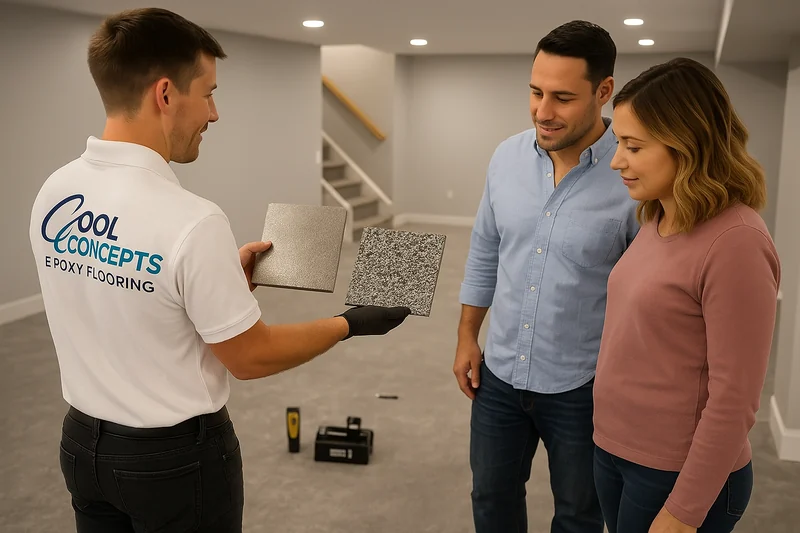
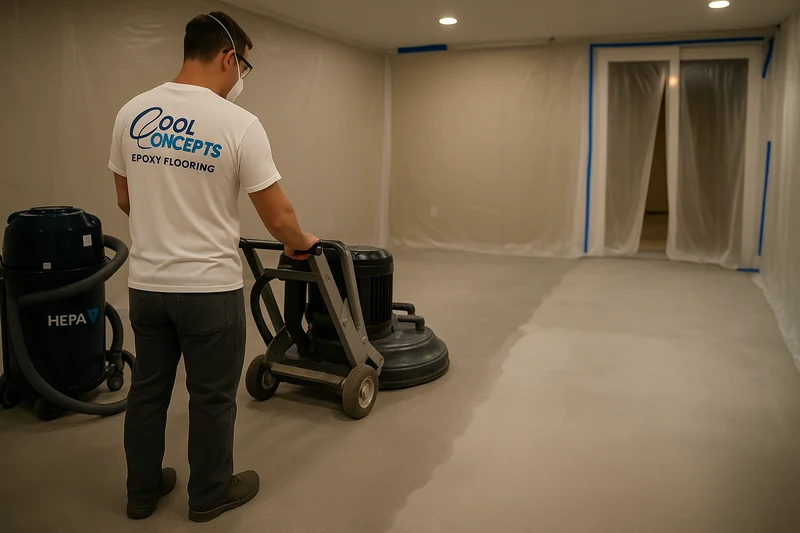
Grind & Moisture Test
2–4 hrsDiamond grinding takes the concrete back to a clean, open profile so the coating has something to key into. Then the reading: ASTM F1869 calcium chloride or ASTM F2170 in-situ RH, on every slab, every time. That number is what decides whether we coat directly or bond a vapor barrier first. It is never a judgement call.
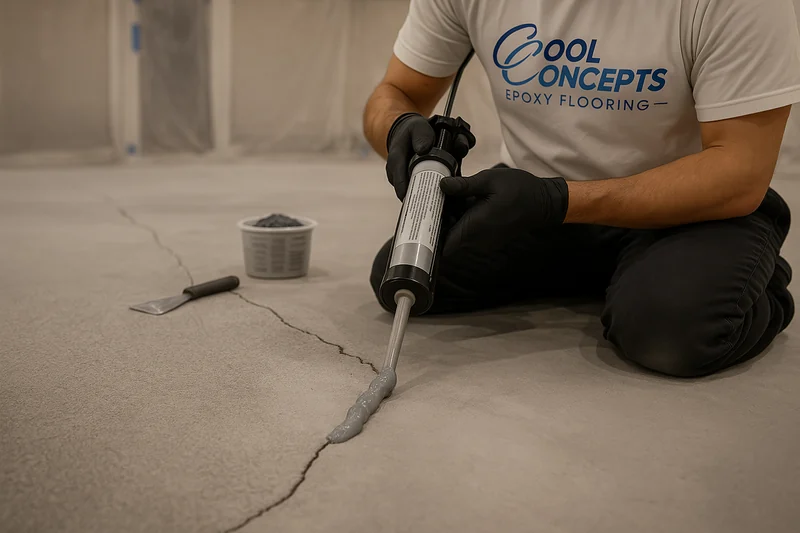
Repair & Vapor Barrier
30–90 minCracks, spalls and divots get filled flush with structural-grade epoxy filler — on forty- and fifty-year-old concrete this is usually the longest part of the day. If the reading came back high, which is common on a slab that has been under standing water at some point, a vapor-barrier primer goes down here so nothing can push the finish off later.
Coat to the Dew Point
3–5 hrsPrimer, body coat, UV-stable topcoat — mixed to what the room is doing that hour, not what the label assumes. The rule every manufacturer's data sheet repeats is to keep the surface at least 5°F above the dew point, with application stopping around 85% relative humidity. Inside a closed, conditioned house those numbers are ours to control, and controlling them is the difference between a glass-smooth cure and a hazy, fish-eyed one.
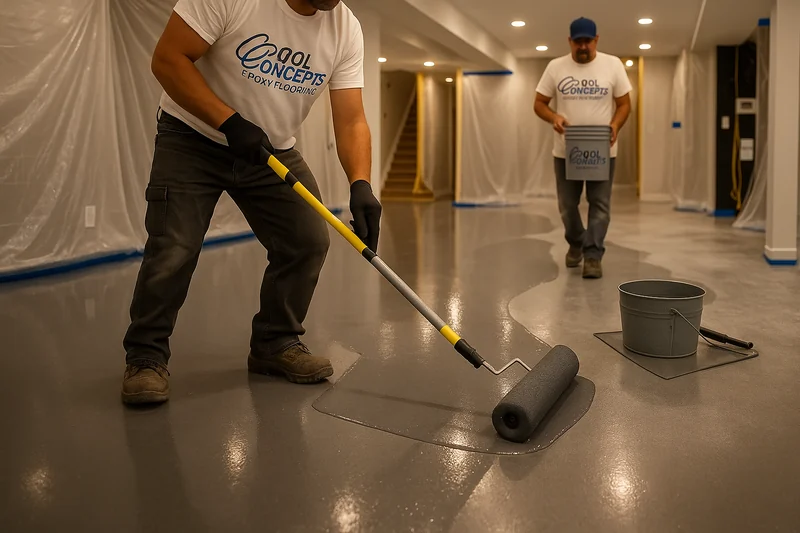
Cure & Enjoy
24–72 hrsCure runs 24-72 hours, and humid air stretches the far end of that, so you get the real number for your job rather than the one on the tin. We walk the finished floor with you before we go and leave a written care guide — rinsing a pool deck, keeping grit off the finish, what to do if something spills and sits.
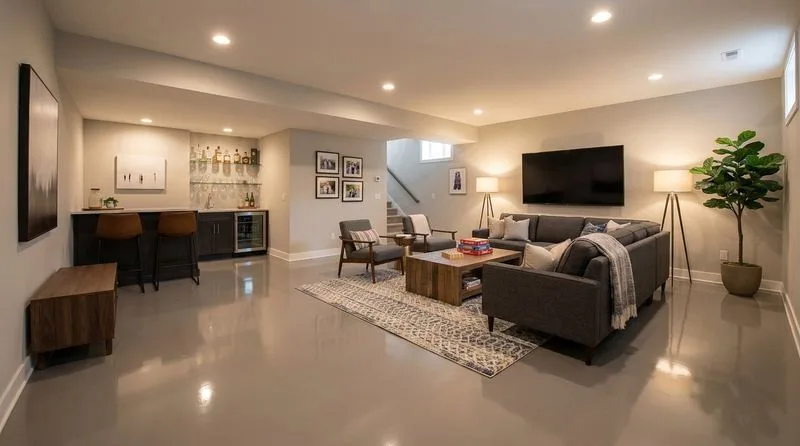
It Starts With a Free Slab Read.
Book a no-obligation visit and we'll check your St. Petersburg slab and lay finish samples down in your own light.
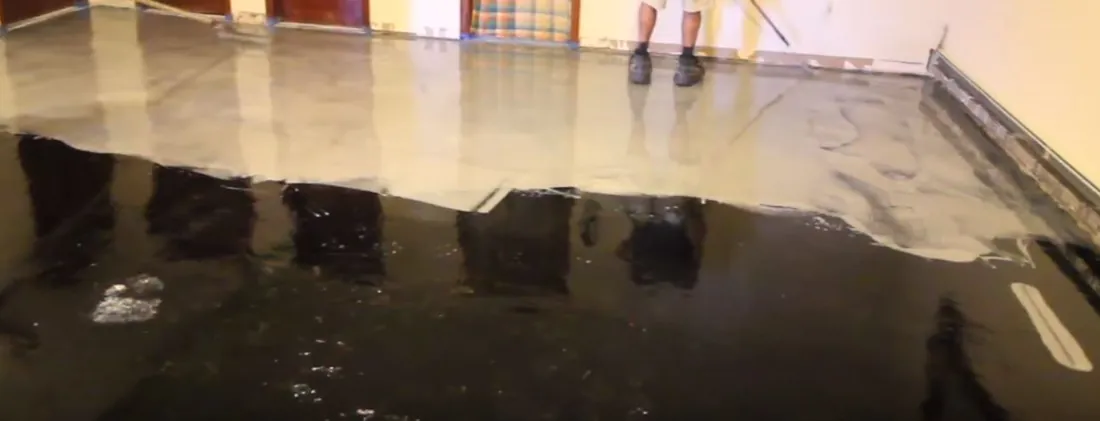
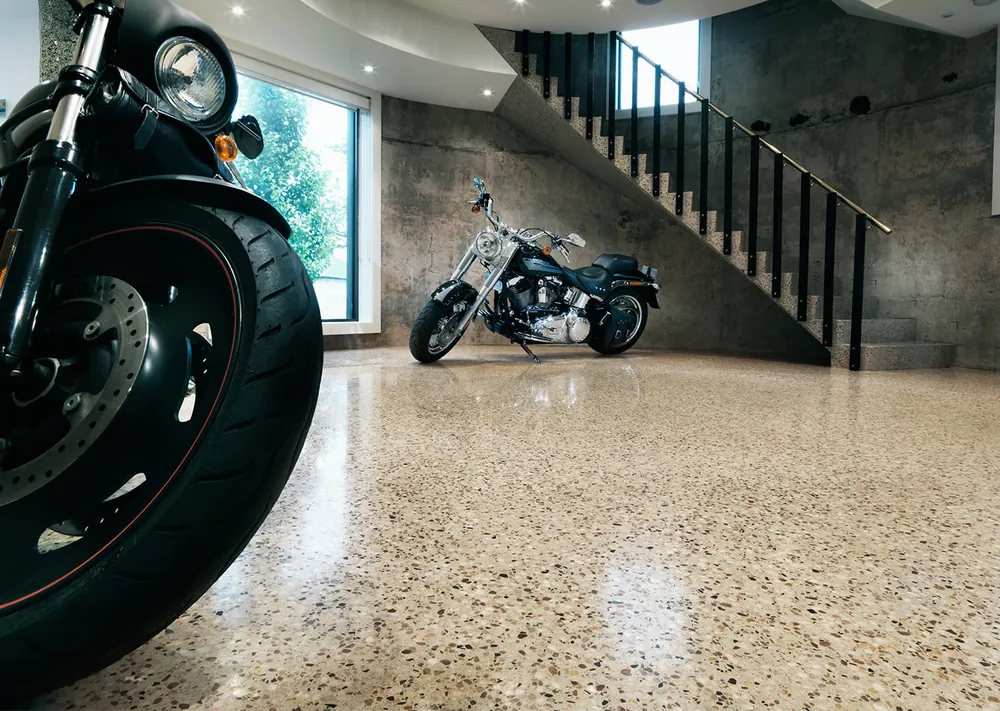
Recent Floors Around the City
Actual installs in actual St. Petersburg houses — lanais, living spaces, garages. Our camera, not a catalogue.
Rated 5.0★ — St. Petersburg Reviews
Real reviews from real St. Petersburg homeowners.
"The work done to my garage was terrific - the technicians were punctual and the price was good. I'm really happy with how it turned out."
"I am really impressed with the quality of their work and their customer service. I see a lot of other companies in the same field, but none of them compare to them."
"Good people, clean work, fast delivery."
Residential Epoxy FAQs — St. Petersburg
Common questions from St. Petersburg homeowners about residential epoxy flooring.
Between $6 and $12 per square foot installed, depending on the finish and what shape the slab is in. Metallic sits at the top of that band, solid color at the bottom. The variables that move it are crack and spall repair, whether the moisture reading calls for a mitigation primer, and room size — small rooms cost more per foot because setup is the same either way. Call (727) 292-1860 and we'll price your actual rooms.
It works well, and the reason is the same one that applies to a shower: a kitchen floor is a wet floor pretending not to be. Epoxy goes down as one waterproof sheet, so cooking oil, wine and whatever the dog knocked over sit on the surface instead of finding a seam. There are no grout lines to grow mildew in humid air, and the decorative flake and metallic ranges give you finishes that read as design rather than as utility.
Almost always the old material has to come up first. Epoxy bonds to concrete, not to tile, vinyl or the adhesive left behind by either — so we take it back to the substrate, grind it, and then meter it, which matters in Florida where nearly everything is slab-on-grade. In a pre-1980 house that tear-out is frequently where the surprises are, which is why we look at it during the free visit rather than on the morning of the install. Call (727) 292-1860 to book it.
Twenty years or more, with the sort of care that amounts to mopping it. What actually decides the number is preparation: a properly ground profile, cracks filled flush, and the slab metered before anything goes on it. Since 67.7% of St. Petersburg housing units went up before 1980, most of the concrete we work on here is already decades old — and reading an old slab honestly is the whole difference between a floor that lasts and one that lifts in its first year.
Usually yes — but only after the slab has been measured rather than guessed at. This city has had reason to ask: the St. Petersburg tide gauge recorded its highest water level on record during Hurricane Helene on 26 September 2024, 6.31 feet above mean higher high water, and Shore Acres has flooded four times in four years. Concrete that has been under water holds it for a long while afterward. So we run an ASTM F1869 calcium-chloride test or an ASTM F2170 in-situ RH probe, check for structural damage, and bond a vapor-barrier system before coating when the reading is elevated. Sometimes the honest answer is that your slab needs more drying time first, and we will say so. Once it is coated, a seamless non-porous floor is far easier to squeegee, dry and disinfect after the next storm than carpet, bare concrete or tile. Call (727) 292-1860 for a free slab assessment.
Design your residential epoxy floor in 60 seconds.
Pick your size, finish, and color. See a real preview and your St. Petersburg price range before you call.
Open Floor Studio →