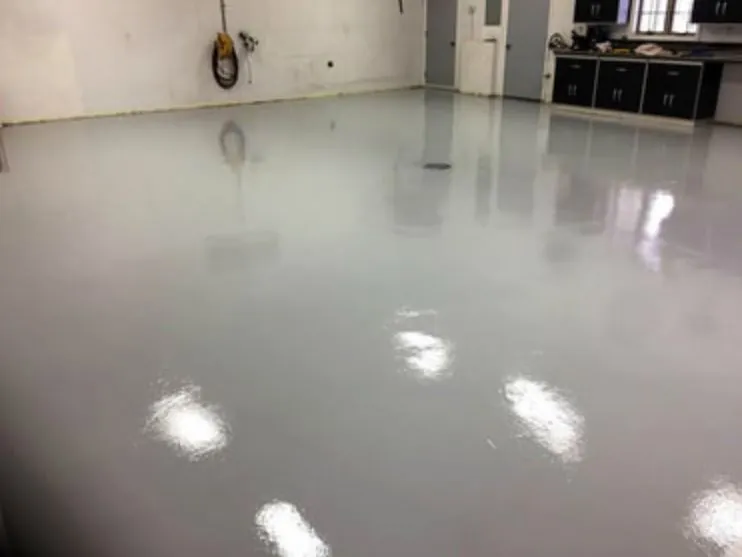
Ten to twenty years for a house garage. Five to ten for a floor that gets worked on. One to three for a kit rolled onto a slab nobody prepared. That spread has almost nothing to do with the resin and almost everything to do with what was done to the concrete first — and, here, with what the floor is asked to survive afterwards.
Underneath the question is a simpler one: am I going to be doing this again, and when? Fair question, and it deserves an answer with a range in it rather than a brochure adjective like “permanent.” Nothing you put on a garage floor is permanent. A well-built coating is a wear layer with a service life, and knowing that life is how you plan for it instead of being surprised by it.
What follows is the range by system, the things that actually take years off a floor in St. Petersburg specifically, the difference between a house garage and a condo deck, and how to tell a recoat from a full rebuild before you have paid for the wrong one. If you would rather have someone look at the floor you already have, call (727) 292-1860.
The Honest Range
Three tiers, and the gap between them is preparation rather than product. A residential floor that got a diamond grind, a moisture reading, and a UV-stable topcoat runs 10 to 20 years before it wants more than a refresh. A working floor — a shop, a warehouse, anything with wheels heavier than a car on it — sits at 5 to 10, because it takes several years of household wear in a single year. And a consumer kit rolled over an untested, unground slab can be lifting inside 1 to 3.
Put plainly: the system you choose sets the ceiling, and the prep decides whether you ever get near it. A cheap system installed properly will outlive an expensive one installed badly, every time. That is not a sales line, it is just what the failures look like when you go and stand on them.
Lifespan by System
The numbers below are for a professionally installed floor with real prep behind it — take that assumption away and the table stops meaning anything. Residential and heavy-use columns are split because the same system genuinely lives two different lives depending on what rolls across it.
| System | Residential Lifespan | Commercial / Heavy Traffic |
|---|---|---|
| Solid Color | 10–15 years | 3–7 years |
| Flake / Chip | 15–20 years | 5–10 years |
| Metallic | 10–15 years | 5–8 years |
| Quartz | 15–20+ years | 8–15 years |
| Polyaspartic Topcoat | Adds years to any base; UV-stable, humidity-tolerant | Adds years to any base; UV-stable, humidity-tolerant |
Two patterns worth pulling out of that table. Flake and quartz outlast the others because the broadcast media is the wear layer — there is physically more material between a tire and the concrete. Metallic sits slightly lower not because the resin is weaker but because the pattern is the product: when a metallic floor wears, you see it, in a way you never see it on a chip floor. And the last row is not a system at all. The topcoat is the part that gets consumed on every one of these builds, which is also why it is the part you can renew without touching anything underneath.
What Actually Wears It Out
Ranked by how often we end up standing on each one in somebody's garage, rather than by how alarming it sounds written down.
A bond that was never really there
Most short-lived floors were short-lived on day one. A coating grips concrete only if the slab has been opened up mechanically — ground, to a profile you can feel with your hand. An acid wash is a rinse. A scuff with a pad is a gesture. Neither leaves anything for the resin to key into, and a floor over unground concrete behaves like a sticker: identical to a real one for about a year, then off in sheets. No product upgrade anywhere on that quote would have changed the outcome.
Sun through an open bay door
An epoxy clear that is not UV-stable will amber. Not might — will, given enough light. It yellows, then goes flat and chalky at the surface, and a floor that was crisp gray at install looks tired two summers later. The failure is cosmetic rather than structural, which is exactly why it stings: the floor is fine, it just looks finished. That is what a UV-stable polyaspartic topcoat is for, and it is why a bay door that stands open half the year is a specification question here rather than a habit.
Hot tires on a warm slab
A tire that has been sitting on hot asphalt is soft and faintly tacky when it parks. On a coating that never bonded properly, or never fully cured, that tire can grab the surface and take it with the car — a clean crescent of missing floor exactly where the wheel sat. Hot-tire pickup is the most recognizable failure in a Florida garage, and it is nearly always a symptom of the first item on this list rather than a problem of its own.
Water, from underneath and occasionally from outside
Vapor travelling up through the slab pushes a coating off from behind, and no topcoat rescues a floor that is failing from below. That is the entire argument for reading the concrete before coating it; our moisture failure guide works through the readings in detail.
The other kind of water is more particular to us. The highest water level ever recorded at the St. Petersburg tide gauge — a record running back to 1947 — was 6.31 feet above mean higher high water during Helene on 26 September 2024, and Shore Acres has taken water four times in four years. So be clear about what a coating does and does not do. It is not a flood-proofing product and no honest installer will sell it as one. What it is, is seamless: no grout lines, no pad, no subfloor, no fibers. Nothing for water to travel under and nothing to hold what the water leaves behind. That is a genuine difference in how a garage cleans up afterwards. It is not a claim that the water stays out.
Where the Years Come From
Four things buy the difference between the bottom of a range and the top of it, and three of them happen before you own the floor — which is worth knowing while you are still choosing who installs it.
- The grind. The whole floor rests on this one decision, and it is the least visible line on a quote, which makes it the easiest one to quietly not do.
- The reading, and a primer only if it is needed. Testing tells you whether vapor is a threat on this particular slab. If it is, a mitigation primer goes first. If it is not, nothing extra gets spent. Guessing gets it wrong in both directions.
- A UV-stable topcoat. The layer that gets consumed should be the one engineered to be consumed slowly, and to not turn yellow while doing it.
- Grit control, mostly. Day-to-day upkeep here is less about cleaning products than about sand. Sand underfoot is an abrasive, and sweeping it out is the highest-return five minutes you will ever spend on the floor. The rest of the routine is in our St. Petersburg maintenance guide, and it is short.
There is a fifth item that is not really maintenance: planning one mid-life recoat rather than waiting for the floor to demand attention. A topcoat refreshed at year eight is a cheap afternoon. A topcoat worn through to the decorative layer at year twelve is a different and much longer conversation.
Wondering How Much Life Is Left in Yours?
Dull is a recoat. Blistering is not. Have someone look at the floor before you decide which one you are paying for — there is no charge for the look.
Homes, Shops and Condo Decks
After preparation, the thing that decides a floor's life is simply what happens on it. Three fairly different situations come up here, and they do not share a number.
A house garage. Two vehicles, foot traffic, a dropped socket now and then. A residential garage floor in flake or quartz with a UV-stable topcoat gets to 15 to 20 years and asks almost nothing of you along the way, which is the part people are usually surprised by.
A working floor. Pallet jacks, point loads, dragged equipment, solvent, a scrubber several times a week. A commercial or industrial floor compresses that same wear into 5 to 10 years, and the spec moves toward a thicker quartz or industrial build to buy some of it back. A warehouse puts a decade of household wear on a floor in a year; that is arithmetic, not a defect. Budget it as a cycle rather than a one-off.
A shared garage deck. This one is specific to St. Petersburg's housing mix — 19 percent of housing units in the city sit in buildings of 20 or more units, per the 2024 American Community Survey. Those floors take constant turning traffic in tight geometry, which is far harder on a coating than straight-line driving, and they are almost never single-owner decisions. Two things typically put a garage deck in front of a board: a milestone inspection, which applies at 30 years, and a structural integrity reserve study for buildings of three or more habitable stories. Worth being precise here, because it is often stated wrongly — floor coatings and garage decks are not enumerated components of a reserve study, and no statute requires you to coat anything. What actually happens is that the study surfaces deferred deck and walkway work, and the coating conversation follows from that.
Recoat or Rebuild
Floors give notice before they quit. Reading the notice correctly is worth real money, because one of these lists is an afternoon and the other is a full tear-out.
Signs pointing at a recoat:
- The gloss has gone flat. The topcoat is thinning under foot traffic and cleaning. Entirely normal, and the earliest thing you will notice.
- Traffic lanes. Visible paths where people walk or where the cars park. The wear layer is doing precisely its job; it is just ready to be renewed.
- Yellowing or a chalky film. A clear that was not UV-stable, ambering in the light. Cosmetic, and the fix is a fresh topcoat — a UV-stable one this time.
Signs pointing at a rebuild:
- Blisters, bubbles or edges lifting. Something under the coating has let go, and nothing you put on top will reattach it.
- A hollow sound when you tap it. Debonded area, whatever the surface looks like.
- Bare crescents where a wheel sits. Hot-tire pickup on a coating that was never properly bonded.
The dividing line
One question settles it: is the base system still stuck to the concrete? If yes, and the complaint is only about the surface, the floor gets scuff-sanded and a new topcoat goes on. Gloss back, wear clock reset, a fraction of a full install. That single mid-life recoat is how a well-built floor quietly outlives its nominal range.
If no — if it is blistering, hollow or lifting — then the part that failed is underneath the part you would be recoating, and coating over it just buys a few months. The failed material comes off, the slab gets re-prepped and read again, a primer goes down if the reading calls for it, and the new floor starts its own full life from zero. Either way, catching it early costs less: a small debonded patch is a repair, and the same patch two years later is the whole floor. If you are seeing anything on the second list, have it looked at before it travels.
Frequently Asked Questions
How long does an epoxy garage floor last in St. Petersburg?
Ten to twenty years for a professionally installed residential floor. The range is that wide because almost all of it is decided before the first coat: whether the slab was diamond-ground, whether it was read for moisture and primed if it needed it, and whether the topcoat is UV-stable. A ground and properly topcoated floor sits at the top of the range. A kit rolled onto an unprepared slab can be peeling inside one to three years.
What wears out a St. Petersburg floor first?
The topcoat, almost always, and usually in one of three ways: sun through an open bay door ambering a clear that was not UV-stable, hot tires lifting a coating that never bonded properly, and grit ground underfoot in the traffic lanes. All three are wear-layer problems, which is the good news — a wear layer is the part you can replace without touching the floor underneath it.
Does a coated garage floor survive flooding?
A coating is not a flood-proofing product and nobody should sell it as one. What it is, is seamless and non-porous: no grout lines, no pad, no seams for water to get under and no fibers to hold what the water leaves behind. In a neighborhood like Shore Acres, which has flooded four times in four years, that is a practical difference in how a garage cleans up afterwards — not a claim that the water stays out.
Can an epoxy floor be recoated instead of replaced?
Yes, as long as the base system is still bonded. If the problem is a dull, scratched or yellowed topcoat, the surface gets scuff-sanded and a fresh topcoat goes on, which resets the wear clock at a fraction of a full install. If the floor is blistering, bubbling or lifting, recoating will not hold, because what failed is underneath the part you would be recoating.
Does St. Petersburg humidity shorten a floor's life?
Humidity matters most on the day the floor is installed rather than over the years afterwards. Relative humidity here runs near 88 percent at 7 a.m. and falls to roughly 57 percent by late afternoon, and most epoxy data sheets cap application around 85 percent — so a coating applied in the wrong hours can cure weak from the start. A floor that cured properly is not being slowly degraded by humid air.
How do I get the most years out of my floor?
Three of the four things that matter happen before you own the floor: the grind, the moisture reading, and a UV-stable topcoat. The fourth is ordinary upkeep — sweep the grit that does the scratching, wipe spills, put pads under anything heavy that gets dragged, and plan on one mid-life recoat rather than waiting for the floor to tell you it is finished.
Have Your Floor Looked At
Nobody can tell you how many years are left in a floor from a photograph, and nobody can tell you how many years a new one will give you without seeing the slab it is going on. Both answers come from the same fifteen minutes on site: what the concrete is doing, what the previous coating did, and which of the wear items above is actually in play. If you already have a floor showing its age, you will get a straight recoat-or-rebuild answer rather than a quote for whichever one is larger.
If you are still at the picturing-it stage, the Floor Studio will show you finishes and sizes with a price range attached, no phone call involved. When you want a person, call (727) 292-1860 or request a free assessment. We work St. Petersburg, Clearwater, Largo, Pinellas Park, Dunedin, Palm Harbor, East Lake, Tarpon Springs and the rest of Pinellas County.
Related Articles
How to Maintain an Epoxy Floor in St. Petersburg
Keep your floor looking new with the right cleaning routine.
Why Epoxy Floors Fail in St. Petersburg — and the Readings That Prevent It
The morning humidity window, the dew-point rule, and the ASTM tests that settle it.
How Much Does Epoxy Flooring Cost in St. Petersburg? (2026 Guide)
Published 2026 prices by finish and what a 400 sq ft two-car bay comes to.