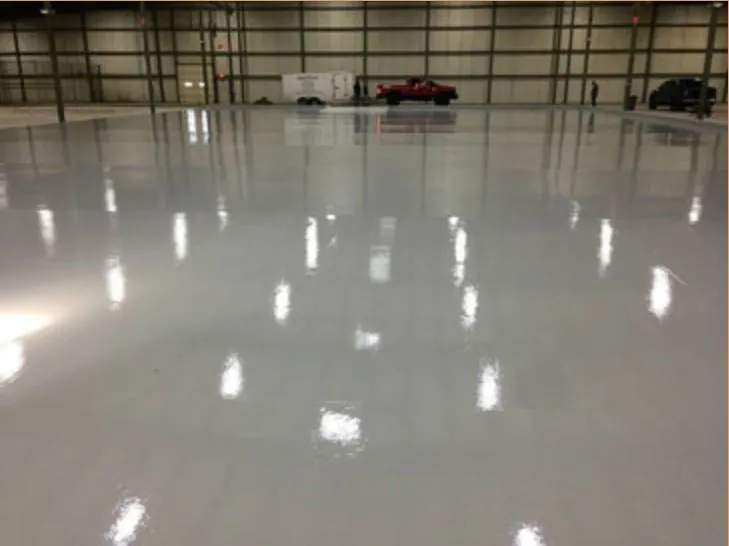
There is no such thing as "a commercial epoxy floor." There are five of them, and specifying the wrong one is how a facility ends up recoating in three years. A distribution floor out at Gateway, a line kitchen in the Grand Central District, a showroom, a repair bay and a clinic each need a different build — and the slab has to be measured before any of them goes down.
Drive the working parts of this city and the flooring problem changes every few blocks. Out at Gateway, where Jabil keeps its headquarters and Raymond James runs a Carillon Parkway campus of more than ten thousand people, the enemy is abrasion: forklift wheels, pallet corners, racking legs. Cross into the Warehouse Arts District and it becomes old concrete under new uses — studios, makers and small production floors in buildings that were never poured for what happens on them now.
Along the Grand Central District and the 49th Street North commercial spine it turns into restaurants and retail, where the floor is inspected one week and judged by a customer the next. Pinellas Park's light-industrial belt adds shop floors and wash bays. Same city, four completely different specifications.
We install commercial and industrial systems throughout Pinellas. Whether it is a new warehouse shell in Clearwater or a tired kitchen in Palm Harbor, what follows should let you read a quote properly instead of comparing two prices that describe different floors. For a number on your own square footage, call (727) 292-1860 and we will come walk it.
One Slab, Five Different Answers
A commercial coating turns bare concrete into one continuous, chemical-resistant surface: no grout, no seams, no open pores for grease or bacteria to sit in. Add a broadcast aggregate or a slip additive and it stays walkable wet. All of that is true of every system on the list below.
What is not true is that the systems are interchangeable. A high-bay distribution floor, a kitchen line, a boutique showroom, a repair bay and a treatment room are asking the coating for five different things: impact, thermal shock, appearance, chemical resistance, static control. Specify for the wrong one and the floor fails at whichever demand you skipped. That is why commercial work is quoted after somebody walks the building rather than off a price list. The system follows the work; the prep follows the slab.
Five Reasons a Facility Owner Signs
Strip the sales language and the case comes down to five things: what it survives, what it hides, how it grips, what it says about you, and what it costs across ten years rather than one quarter.
It Survives the Traffic You Actually Run
Bare concrete under commercial load dusts, spalls and stains. A bonded epoxy or polyaspartic build puts a hard wear layer between the slab and everything that happens on it — forklift wheels, dropped tooling, dragged pallets, rolling racks. In a warehouse the damage always announces itself in the same two places first, the main travel lane and the apron inside the dock doors, and those are exactly the areas where an uncoated slab starts to pit.
Nothing to Hide In
No grout, no seams, no pores. A spill sits on top and gets squeegeed instead of absorbed, and there is nowhere for grease or mold to establish itself. For any operation that gets inspected — food service, food production, clinical space — a seamless floor is part of staying compliant rather than a nice-to-have. In air this humid, a sealed surface also removes one more place for damp to sit unnoticed.
Traction You Can Specify by Zone
A wet floor is a liability line item. Broadcast aggregate or an anti-slip additive gives a defined traction profile, and it can be set zone by zone rather than building-wide: aggressive on a kitchen line or a wash bay, lighter where an easy-to-mop surface matters more than grip. Deciding that room by room is one of the things the walkthrough is actually for.
The Floor Is Part of the First Impression
A uniform, glossy floor reads as a well-run operation before anyone says a word. In a Grand Central District storefront it can be tinted, flaked or poured as a metallic and become part of the brand outright. Back of house it does something quieter but just as useful: it tells staff and inspectors that the building is looked after.
The Number Works Over a Decade, Not a Quarter
The commercial case is never the cheapest quote today. It is cost across ten years. A well-installed floor commonly runs a decade or more, it prevents the slab damage that turns into concrete repair, and it cuts cleaning labor because there is nothing to scrub out of. Our guide to how long an epoxy floor lasts here works through the lifespan side of that math.
Sorted by What the Floor Has to Survive
The most useful sorting is not by product. It is by the punishment. Here is how the specification shifts across the buildings we coat most often around Pinellas.
Distribution and Warehouse Floors
These live or die on abrasion and impact. Forklifts and loaded racks work the slab continuously, so the priority is a hard wear layer, plus line striping for travel lanes and safety zones. Solid-color or flake epoxy under a polyaspartic topcoat handles most distribution floors. On buildings that open to the outdoors, the perimeter and the dock aprons get the tougher spec, because that is where weather and traffic meet.
Kitchens and Food Service
The hardest commercial environment there is: standing water, hot oil, grease, caustic cleaning every night, and thermal shock from hot water and steam. A quartz broadcast earns its place here because it is seamless and sanitary. Traction is mandatory on a line. This is almost always walkthrough-quoted, because layout and code requirements drive the build more than square footage does.
Retail, Showrooms and Studios
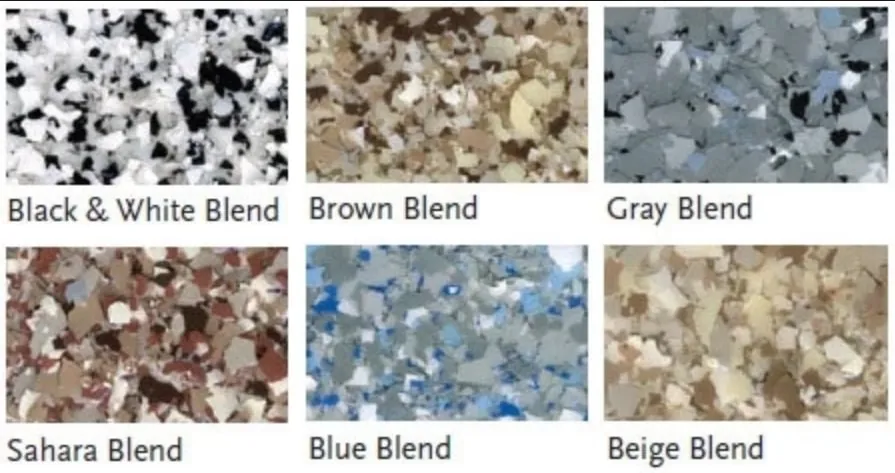
Here the floor carries traffic and a brand at once. Flake hides scuffs down a busy aisle; metallic turns the floor into the reason somebody takes a photo. The topcoat still has to resist wear and hold its gloss, but the conversation leans toward color and finish. Warehouse Arts District buildings add a wrinkle: the concrete is often decades old and previously coated, and stripping and profiling it properly is most of the job.
Repair Bays and Shop Floors
Bays take hot-tire pickup, oil, brake fluid, solvents and the point loads of jacks and lifts. A flake system with a chemical-resistant polyaspartic topcoat is the workhorse: it resists staining from automotive fluids, cleans up fast, and adds grip when the floor goes slick. The flake also disguises the marks a working bay collects, so the space still looks sharp several years in.
Clinical and Lab Space
Clinics, labs and treatment rooms need seamless, disinfectable surfaces with coved bases so there is no dirt-trapping corner where wall meets floor. Quartz and high-build epoxy fit. Infection control sets the spec, and the seamlessness is what makes daily disinfecting actually work rather than just look like it does.
Want a Spec for Your Building?
Tell us the square footage, the trade, and your hours. We will walk the slab, name the system, and put a real number on it — free.
The Three Builds and Where Each Fits
Each system trades durability, traction, chemical tolerance and cost differently. The table is a starting point only — the final spec gets set once we have seen the concrete and watched how the space is used.
| System | Best Use | Durability | Slip Resistance | Notes |
|---|---|---|---|---|
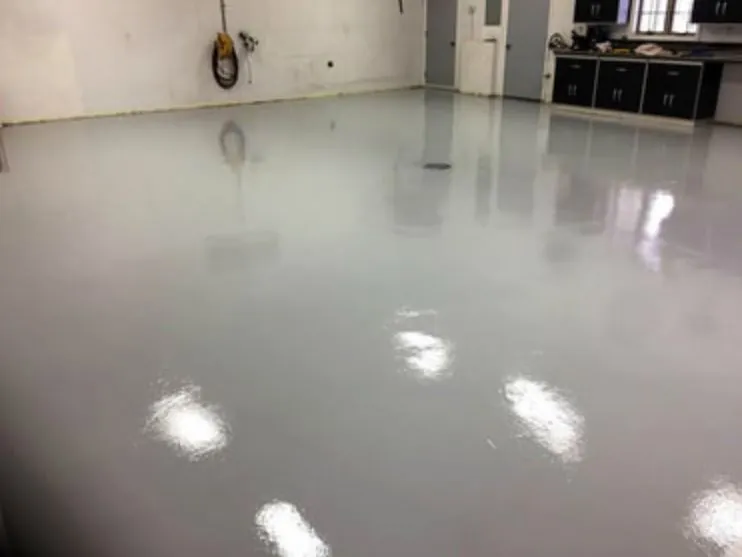
| Solid Color Epoxy | Storage, back-of-house, light commercial | Good | Low (additive optional) | Entry point; clean, glossy, quick to mop |
| Flake / Chip | Retail, repair bays, general commercial | Very good | Medium | Disguises wear; wide color range |
| Quartz Broadcast | Kitchens, clinics, locker rooms, food service | Excellent | High | Thick, hard, sanitary; walkthrough-quoted |
For general commercial and retail, flake under a polyaspartic topcoat is the all-around value. For kitchens and food service, quartz is the sanitary, slip-rated answer. If you are weighing a coating against simply grinding and sealing what you already have, our polished concrete page covers that alternative honestly.
Three Things This Peninsula Does to a Commercial Floor
A specification that performs on a dry inland slab can fail quickly here. Three local conditions shape nearly every commercial quote we write.
Measure the Slab Before You Price the Floor
Commercial slabs are large, and a moisture problem on a large slab is not a patch — it is a bay. Vapor moving up through concrete pushes a coating off from underneath, and it does that quietly for weeks before anything shows on the surface. So the number that has to exist before the quote is a measurement, not an opinion: a calcium chloride test to ASTM F1869, or in-situ relative humidity probes to ASTM F2170 for a reading through the depth of the slab. Where transmission comes back high, a mitigation primer goes down first, roughly $1.50 to $3.00 per square foot, with the test itself $200 to $400. On a commercial job that is not an upsell. Relative to what it prevents, it is the cheapest line on the page.
Condo Boards, Garage Decks and Ground-Floor Bays
Nineteen percent of St. Petersburg's housing units sit in buildings of twenty units or more, which means a good share of the local commercial flooring conversation is really a board conversation. Milestone inspections at thirty years, and structural integrity reserve studies for buildings of three habitable stories and up, have put a lot of associations in front of their own concrete for the first time in years, and a reserve study routinely surfaces deferred work on garage decks, walkways and trash rooms. To be exact about the law: a floor coating is not an enumerated component in a reserve study, and nothing obliges an association to coat anything. What the study does is tell a board the concrete needs attention. Coating it is often the sensible thing to do once the repair is finished.
Ground-floor bays near the water carry their own history. The highest water level ever recorded at the St. Petersburg gauge — on a tide record running back to 1947 — was 6.31 feet above mean higher high water, during Helene on 26 September 2024. Buildings that took water then have concrete with a story attached, and a seamless coating on a ground-floor bay or a loading area is far easier to clean and dry out than anything with a seam in it. Open bays and dock doors also sit in salt air, which pushes the spec toward a thicker, tougher build around the exposed perimeter.
Off-Hours Work Lands in the Worst Air of the Day
Here is a scheduling detail most facility owners have never been told. Relative humidity in St. Petersburg runs about 88% at 7 a.m. and only falls to roughly 57% by late afternoon, while manufacturer data sheets cap application near 85% RH. Overnight and pre-dawn installs — precisely the ones a restaurant or a retail floor needs — therefore land squarely in the hours the product sheet tells you to avoid. The same sheets ask for the surface to sit at least 5°F above the dew point through application and cure, which is the rule every manufacturer's data sheet repeats.
That is workable. It is not ignorable. It means closing the building up and running dehumidification, taking honest readings before anything is mixed, and using fast-cure polyaspartic chemistry to close the floor while the numbers still allow it. A crew willing to coat an open building at five in the morning without measuring anything is a crew that will be coming back.
Price Ranges and the Four Variables That Move Them
Commercial pricing runs on the same per-square-foot logic as residential, but the spread is wider and the variables carry more weight. Current St. Petersburg ranges by system, installed:
| System | Cost Per Sq Ft (installed) |
|---|---|
| Solid Color Epoxy | $4–$7 |
| Flake / Chip | $5–$9 |
| Metallic | $9–$14 |
| Quartz | $10–$14 |
Four things move a commercial number enough that quoting blind is guessing:
- Square footage. Bigger floors lower the per-foot rate, because mobilization and setup spread across more area — while raising the total. A 3,000 sq ft shop and a 40,000 sq ft distribution floor are not the same job at a different size.
- What the slab is currently doing. Cracks, spalling, oil contamination, an old coating that has to come off. Sound concrete grinds and coats quickly; contaminated or previously coated concrete needs remediation first, and that is where estimates diverge.
- The build itself. A solid-color storage floor is a fraction of a multi-coat quartz clinic. The system is set by the work the floor does, not by preference.
- Moisture mitigation. When the reading comes back high, add roughly $1.50 to $3.00 per square foot plus $200 to $400 for the test. Across a large floor that is a real line item, and skipping it is how the whole floor becomes one.
For how the underlying finish ranges break down, our St. Petersburg epoxy flooring cost guide goes through them finish by finish.
Keeping the Doors Open While It Goes Down
Behind "how much" there is almost always a second question: how long am I closed. For a restaurant or a shop, a week of lost trade can cost more than the floor. A commercial installer who is any good plans the job around your operation instead of asking your operation to plan around the job.
Two levers do most of the work:
- Fast-cure polyaspartic. Where a traditional epoxy wants days between coats, a polyaspartic build can take foot traffic within hours and go back into full service quickly. In this climate it is also the more predictable cure, so the speed is not bought at the price of a weaker floor.
- Phasing and off-hours sequencing. A large floor gets coated in sections so part of the building keeps working. Overnight and weekend windows keep a retail or food-service space trading through business hours. In a warehouse, sequencing by zone lets operations move around the crew instead of stopping for it.
Which combination applies depends on your layout, your hours and how the space actually flows — which is the real reason a commercial quote starts on site. We map the sequence to your schedule before any product is opened.
What Facility Owners Ask First
How much does commercial epoxy flooring cost?
Between $4 and $14 per square foot installed in St. Petersburg, depending entirely on the build. Solid-color sits at $4 to $7, flake at $5 to $9, and quartz at $10 to $14. Square footage, slab condition and the system itself vary so much between buildings that commercial and quartz projects are quoted after a walkthrough rather than off a list.
How long does a commercial epoxy floor take to install?
Two to five days is typical, driven by area, prep and coat count. A fast-cure polyaspartic build compresses that and allows foot traffic within hours of the final coat, which is why it is the default whenever downtime is the binding constraint.
Can you install epoxy without closing my business?
Frequently, yes. We phase installs by section, work overnight and weekends, and use fast-cure coatings so an area can return to service quickly. Which approach fits depends on your layout and your hours, which is one more reason the process starts with a walkthrough rather than a phone number.
What is the best floor for a commercial kitchen?
A quartz broadcast, for most kitchens here. It is seamless, sanitary and slip-rated. The final spec follows a walkthrough of the space and its code requirements.
How long does a commercial epoxy floor last?
Ten to twenty years under normal traffic when the slab was prepped properly and moisture was addressed. High-impact industrial floors sit at the lower end of that band; light commercial space with routine maintenance can run past it.
Does commercial epoxy need moisture mitigation in St. Petersburg?
Sometimes, and the only way to know is to measure. We run a calcium chloride test to ASTM F1869 or in-situ probes to ASTM F2170 before quoting. Where the reading comes back high, a mitigation primer is added at roughly $1.50 to $3.00 per square foot, with the test itself $200 to $400. On a large slab that primer is the cheapest insurance on the job.
Book a Walkthrough
A commercial number cannot honestly be produced over the phone, and anyone who gives you one has guessed at the two variables that move it most: what your slab is doing and how your operation runs. Every commercial estimate we write starts with somebody standing in the building, a moisture reading, and a plain recommendation covering system, sequencing and hours.
Call (727) 292-1860 or request a walkthrough online. We take commercial work across Pinellas — the Gateway corridor, the Warehouse Arts District, downtown St. Petersburg, Pinellas Park, Largo, Clearwater, Seminole, Dunedin, Palm Harbor and Tarpon Springs. To picture a finish before you call, the Floor Studio previews colors and systems in about a minute.
Related Articles
How Much Does Epoxy Flooring Cost in St. Petersburg? (2026 Guide)
Real 2026 St. Petersburg prices by finish plus a typical 2-car garage total.
How Long Does an Epoxy Floor Last in St. Petersburg?
Realistic lifespans and what makes a St. Petersburg floor last.
Metallic Epoxy Flooring in St. Petersburg
Metallic, flake, and quartz design options compared.