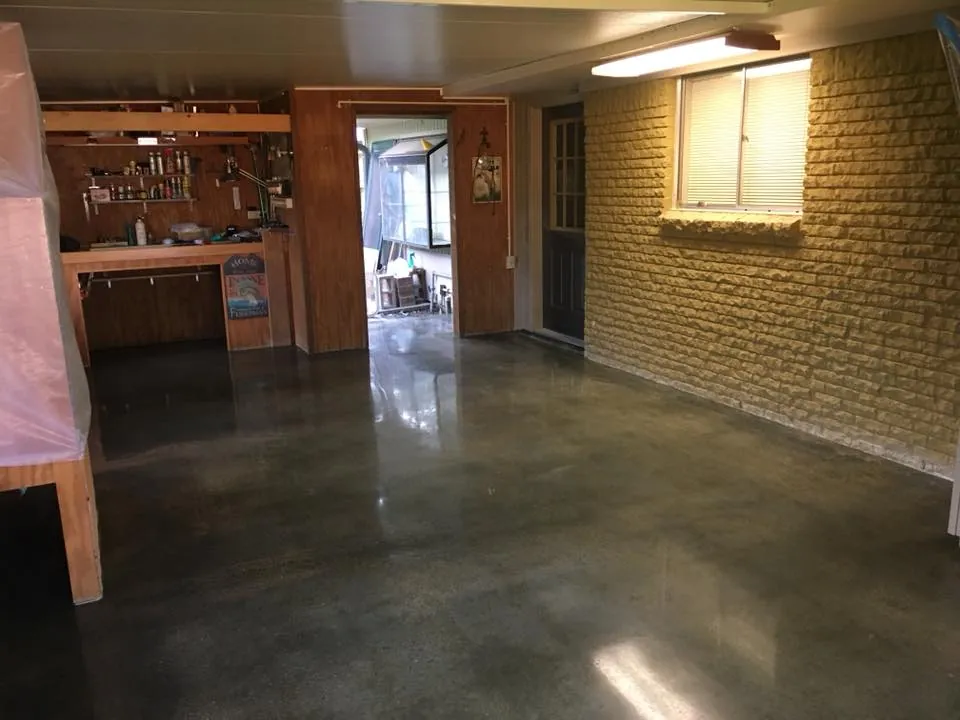
Sweep the grit off, mop with a pH-neutral cleaner, wipe spills while they are fresh, and keep acids and abrasive pads away from it. That is the whole job. On the Pinellas peninsula, add two habits the manuals leave out: mats against tracked sand and salt, and a plan for the days water gets in.
A cured epoxy or polyaspartic floor asks very little of you. It is seamless and non-porous, so spills sit on top instead of soaking in, and there is no grout line anywhere to scrub. The short list of things that genuinely shorten a coated floor's life is almost entirely accidental — the wrong bottle from under the sink, a green scour pad, a toolbox dragged the length of the bay.
Where St. Petersburg departs from a generic care guide is not the cleaning method. It is what ends up on the floor. We are on a peninsula: sand arrives on shoes, salt arrives on the air, the slab sweats on humid mornings, and in a bad week water arrives under the door. Each of those has a plain answer, and none of them involves buying a special product.
Whether yours is a chip garage floor in Largo or a metallic front room in Crescent Heights, everything below applies the same way. If your floor already needs more than a mop, our repair and maintenance service can take a look — call (727) 292-1860.
The Short Answer
One idea covers most of it: get the grit off, and reach for the gentlest thing that works. These coatings shrug off chemicals and water, but like any clear finish they can be scratched dull by abrasion and etched flat by acid. Five habits and you are done.
- Sweep or dust-mop often so sand never gets the chance to be ground in by a shoe or a tire.
- Damp-mop with pH-neutral cleaner and warm water on a soft microfiber head when a sweep is not enough.
- Catch spills the same day — oil, brake fluid and solvents lift off easily while they are fresh.
- No acids, no abrasives — that means no vinegar, no citrus degreaser, no green pads, no wire brush.
- Rinse coastal floors — a hose or a moderate pressure-washer setting is fine on a sound, cured floor and gets salt off fast.
Everything below is the reasoning behind those five, plus the handful of things that are specific to living here.
The Routine, Start to Finish
The routine has two halves: clear the grit constantly, wash properly once in a while. Get the first half right and the second half comes around less often.
The 60-second pass
Sweeping is worth more than every product on the shelf combined. What wears a clear topcoat down is not water, and it is not mild detergent — it is fine grit, dragged back and forth across the surface by shoes, tires and rolling tool chests until it has done the work of sandpaper. Clearing that grit before it is trodden in is the entire game. A minute with a dust mop or a soft broom every few days will hold the gloss on a working garage longer than any coating additive ever advertised.
The proper wash
When a sweep no longer cuts it, damp-mop. Warm water plus a pH-neutral cleaner — look for "coated," "sealed" or "epoxy" on the label — diluted the way the bottle says. Work in sections with a flat microfiber head and change the rinse water when it turns gray, otherwise you are redistributing dirt rather than removing it. Resist the urge to flood it; the surface is non-porous, the water has nowhere to go, and a damp head is all that is needed. Air-dry or pull it dry with a clean pad. Weekly suits most garages. A quiet interior floor is often fine monthly.
| Task | How Often | How |
|---|---|---|
| Sweep / dust-mop | Every two or three days | Soft broom or dust mop — the habit that matters most |
| Damp-mop | Weekly, monthly indoors | Flat microfiber, warm water, pH-neutral cleaner |
| Spot-clean a spill | Same day | Soft cloth, mild cleaner, before it dries on |
| Fresh-water rinse | More often near the water | Hose or moderate pressure setting to flush salt |
Mopping Stopped Bringing the Shine Back?
That usually means the clear coat has taken the wear it was there to take. Tell us what you are seeing and we will come and look, at no charge.
What NOT to Use on an Epoxy Floor
Far more coated floors are ruined by a cleaning product than by traffic. The slab underneath can be perfect while the clear coat over it is etched, hazed or scratched, and once that happens no amount of mopping brings it back. Three categories to keep off the floor.
Acid, in all its friendly disguises
This is the one that does the most damage, because the products are the ones already in the house. Vinegar. Lemon and citrus degreasers. Most tile, grout and bathroom cleaners. All acidic, all capable of etching a clear coat a little more each time until the shine is gone for good. Vinegar gets reached for because it is "natural," which has nothing to do with whether a coating can tolerate it. And muriatic acid or any concrete etcher belongs to the prep stage on bare concrete — putting it on a finished floor is not a cleaning decision, it is a stripping decision.
Anything that scratches
Green scour pads, steel wool, wire brushes, stiff bristle scrubbers: each leaves fine scratching that catches the light and reads as a cloudy patch in the traffic lane. If a mark needs agitation, a soft deck brush or a white non-abrasive pad plus a few minutes of dwell time will get there. Let the chemistry do the work; muscle is what damages the finish.
Industrial degreasers and solvents
Heavy-duty degreasers, ammonia, bleach, acetone and paint thinner can soften, cloud or discolor a topcoat with repeated contact. Everyday garage grime does not need any of them. Keep them for the rare genuine problem, use them on the spot rather than the whole floor, and rinse straight away. A simple test: if the label boasts about stripping finishes, believe it.
| Avoid | Use Instead |
|---|---|
| Vinegar, citrus degreaser, tile & grout cleaner | pH-neutral cleaner labeled for coated floors |
| Green pads, steel wool, wire brushes | White non-abrasive pad or soft deck brush |
| Bleach, ammonia, heavy degreasers, day to day | Warm water and a mild pH-neutral mix |
| Acetone, paint thinner, muriatic acid | Spot only, if at all — rinse immediately after |
What the Peninsula Adds to the Job
Nearly every epoxy-care article online was written for somewhere dry and somewhere inland. Four things about living between the Gulf and the bay change what actually lands on your floor, and all four have straightforward answers.
Sand and salt do the real wearing
Sandy yards, a short drive to Treasure Island or St. Pete Beach, and salt carried on the air mean a floor here accumulates fine abrasive at a rate an inland garage never sees. That grit, not water and not cleaner, is what scratches a clear coat. Two responses, both boring and both effective: sweep more often than feels necessary, and put a heavy walk-off mat everywhere the outside meets the inside — where the garage door meets the driveway, and inside any door coming off a lanai or pool deck. A good mat protects a topcoat better than anything sold in a bottle.
Condensation is a morning problem, not a storm problem
Most people expect the afternoon downpour to be the humid part of the day. It is not. Relative humidity here sits near 88% at 7 a.m. and falls to roughly 57% by late afternoon, which is why a cool slab is at its most likely to sweat first thing, before anyone has opened the garage. On a properly sealed floor that condensation is harmless — the coating is non-porous, and the water is sitting on top of it — but it will make the surface briefly slick, and if it is left to dry with dust on it you get a grimy film. Sweep it, and give a closed-up garage some air on a muggy morning. This is a surface-weather issue and has nothing to do with moisture pushing up through the slab, which is a preparation problem rather than a cleaning one.
When water gets in
This is the section a Midwestern care guide will never have. Roughly two-thirds of the year's rain falls between June and September, and the peaks are not gentle: Albert Whitted recorded 18.54 inches in a single calendar day during Milton, the heaviest calendar-day total in a record that goes back to 1998. Shore Acres has taken water four times in four years. And the highest water level ever recorded at the St. Petersburg gauge — 6.31 feet above mean higher high water, set by Helene on 26 September 2024 — beat a mark that had stood since Elena in 1985.
A seamless coating is genuinely the best floor to own when that happens, because there is nothing for water to get underneath and nothing porous to hold what it leaves behind. The work is in the hours after it drains, not during. Push the standing water out, then rinse the whole floor with fresh water before it dries: brackish water dries to a white salt film, and salt left sitting at the edges and in the door track is what starts trouble later. Squeegee it dry rather than letting it evaporate, get airflow moving through the space, and lift anything wet — cardboard, rubber mats, carpet offcuts — off the surface instead of leaving it to sit for a week. Then look along the edges and any expansion joint in daylight. A lifted edge or a soft spot found now is a small repair; the same spot found in six months is a bigger one.
Lanais and pool decks live outdoors
A coated lanai or pool surround takes sun, splash, chlorine and tracked sand all year. Hose it down regularly so pool chemistry and salt do not sit on the finish, keep the grit swept, and move things around: a wet towel, a rubber mat or a planter left in the same square foot for a month can leave a mark, and rubber in particular can transfer color into a clear coat. The reason we specify a UV-stable polyaspartic topcoat on anything exposed is what happens out there without one.
Shifting the Usual Marks
A non-porous surface means almost nothing soaks in, so the rule for every mark below is the same: get to it early and it comes off with a cloth. Leave it and you are working harder for the same result. Five that come up constantly.
Hot-tire pickup
A tire that has been out on a summer afternoon comes home hot and sticky, and against a weak coating it will grab, leaving a cloudy or tacky patch where the car sat. A properly installed polyaspartic topcoat largely takes this off the table. If it does appear, dwell a pH-neutral or coating-safe degreaser on the patch, agitate with a soft brush or white pad, then rinse. Never a scour pad and never a solvent. Prevention costs nothing: park on a mat through the hottest stretch of the year, or simply move the car a few inches every so often.
Salt film after a wet week
Brackish water and salt spray dry to a chalky white haze. It looks alarming and it is not: the salt is sitting on the coating, not in it. Rinse with fresh water, damp-mop with a pH-neutral cleaner and dry it off. What matters is doing it rather than leaving salt to sit in the door track and along the edges.
Oil and grease
Blot fresh oil with paper towel first, then clean the spot with warm water and pH-neutral cleaner. A stubborn film usually surrenders to a dab of mild dish soap on a soft cloth, well rinsed after. Nothing here is going into the concrete the way it would on a bare slab — you are washing a surface, not drawing a stain out of one.
Rust marks
Rust means metal has been sitting on a damp floor: a jack, a hand tool, the foot of a steel shelf. Move the object, dry the area, and lift the mark with pH-neutral cleaner and a soft brush. Do not reach for a rust remover — those are acid, which is precisely what etches a clear coat. Felt pads or a plastic barrier under metal feet stops it recurring.
Dried paint, caulk and the like
Work a plastic putty knife or an old credit card under one edge and it generally releases in a sheet, because there is nothing porous for it to have keyed into. Never use a metal blade; it will gouge the coating and that damage is permanent. Clean off the residue with a mild cleaner. If something has cured into a hard film and refuses to move, stop before you scratch the floor trying and let us deal with it.
Habits That Buy You Years
Cleaning maintains a floor. Habits extend it. None of the five below is fussy, and together they are the difference between a recoat in a handful of years and one much further out.
- Mats where the outside comes in. A walk-off mat at every threshold intercepts sand before the floor ever sees it. A second mat under a workbench or in the parking bay absorbs dropped tools and hot tires.
- Carry it, do not drag it. A toolbox, an appliance or a bike stand dragged across the floor grinds trapped grit into the coating and can gouge straight through. A dolly with soft wheels, or a second pair of hands, costs less than the repair.
- Pad everything with feet. Felt or rubber under shelving, cabinets and furniture legs prevents both point-load scratching and rust rings. Non-marking casters do the same job on anything that rolls.
- Watch heat and sharp edges. Put a board or a stand under a running engine, a fire pit or anything with an exposed blade. The coating is genuinely tough, but sustained direct heat and a dropped edge are two things that still mark it.
- Rinse if you are near the water. Fresh water on the floor now and then stops salt accumulating at the edges and along an open bay, which is where it does its damage.
Do those things and the gloss holds for a long time. What follows is how to tell when it finally stops holding.
Knowing When to Recoat
The clear topcoat is designed to be sacrificed. It absorbs the wear so the color or chip layer beneath it never has to, and the whole trick is refreshing it while there is still topcoat left to refresh. Caught at the right moment it is a straightforward job. Caught late it is a rebuild.
Four things say the moment has arrived:
- Flat lanes, shiny edges. The gloss has gone from where the car and the feet go, while the perimeter still reflects. The clearest signal there is.
- A hazy cast across the surface from accumulated fine scratching, which no amount of mopping lifts.
- A chip or a lifted patch anywhere — deal with it while it is the size of a coin, not after traffic and water have opened it up.
- Marks that used to wipe off and now do not. Usually means the topcoat has thinned to the point where it holds onto things.
Surface wear is a clear-coat refresh and the floor comes back. Actual chipping, bubbling or delamination is a different conversation, particularly if there is any sign of moisture under the coating, and it needs someone standing on the floor to diagnose. For what a well-built floor should realistically give you here before any of this comes up, see how long an epoxy floor lasts in St. Petersburg; if you are pricing a new one, the St. Petersburg cost guide has the ranges. When the time comes, our repair and maintenance service handles both the refresh and the repair.
Frequently Asked Questions
How do you clean an epoxy garage floor?
Clear the grit first with a dust mop or a soft broom, because grit is what actually abrades a topcoat. Then damp-mop with a flat microfiber head, warm water and a pH-neutral cleaner, changing the rinse water instead of pushing the same dirt around. Deal with spills the day they land and you will almost never reach for anything stronger.
Can you use vinegar on an epoxy floor?
No. Vinegar is an acid, and acids etch a clear coat. The same warning covers citrus degreasers and most tile, grout and bathroom products: used repeatedly they pull the gloss down to a flat haze that cannot be mopped back. A pH-neutral cleaner labeled for coated floors is the only thing this surface needs week to week.
How do you remove hot-tire marks from epoxy?
Wet the mark with a pH-neutral or coating-safe cleaner, give it a few minutes to dwell, then work it with a soft-bristle brush or a white non-abrasive pad and rinse clean. Green pads, wire brushes and strong solvents will scratch or cloud the finish and are not worth the risk. The real defense is upstream: a proper polyaspartic topcoat resists hot-tire pickup far better than a thin DIY kit ever will.
How often should you reseal or recoat an epoxy floor?
There is no fixed interval. A professionally installed floor with a polyaspartic topcoat runs for years, and the floor itself tells you when it is ready: the gloss goes flat in the driving lanes while the edges still shine. Refresh the clear coat at that point, while the color or chip layer underneath is still untouched, and it costs a fraction of what waiting for wear-through costs.
Will a pressure washer damage an epoxy floor?
On a sound, fully cured floor, no. Rinsing with a hose or a pressure washer at a moderate setting and a sensible distance is one of the advantages of a seamless coating, and on a coastal floor it is the quickest way to get salt off. Keep the tip moving, never park it against the surface at full pressure, and stay off any edge or chip you already know about, because concentrated spray can lift a weak edge.
Get Your Free St. Petersburg Quote
Every habit on this page is easier on a floor that was built correctly to begin with. Ours start with a full diamond grind rather than an acid wash, and finish with a UV-stable polyaspartic clear coat chosen for salt air, hard sun and a humid morning — which is most of what makes a floor here low-maintenance in the first place.
New floor or an old one that needs bringing back, call (727) 292-1860 or request a free quote online. Prefer to look before you talk? The Floor Studio puts a size, a finish and a color together with a real St. Petersburg price range attached. We work across Pinellas: St. Petersburg, Gulfport, Pinellas Park, Largo, Seminole, Clearwater, Dunedin, Palm Harbor, East Lake and Tarpon Springs.
Related Articles
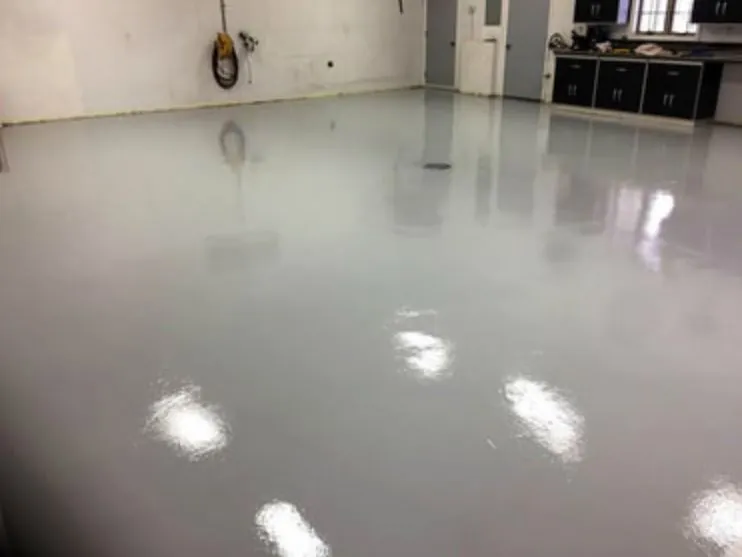
How Long Does an Epoxy Floor Last in St. Petersburg?
What a properly built floor actually gives you, and what shortens it.
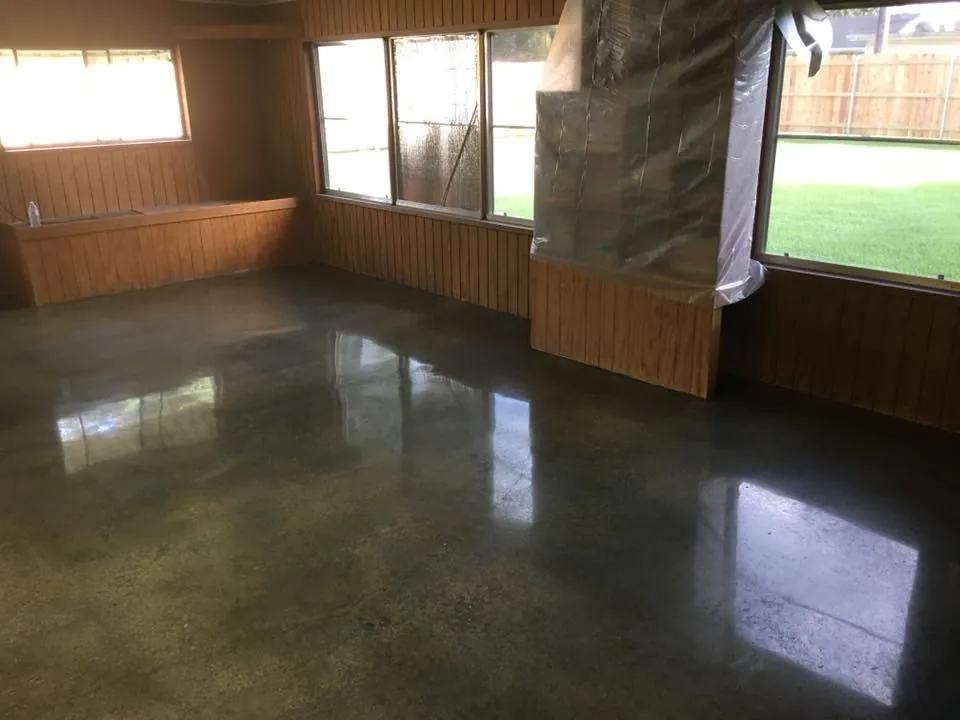
Why Epoxy Floors Fail in St. Petersburg — and the Moisture Test That Prevents It
Slab moisture, the ASTM tests that catch it, and what to ask first.
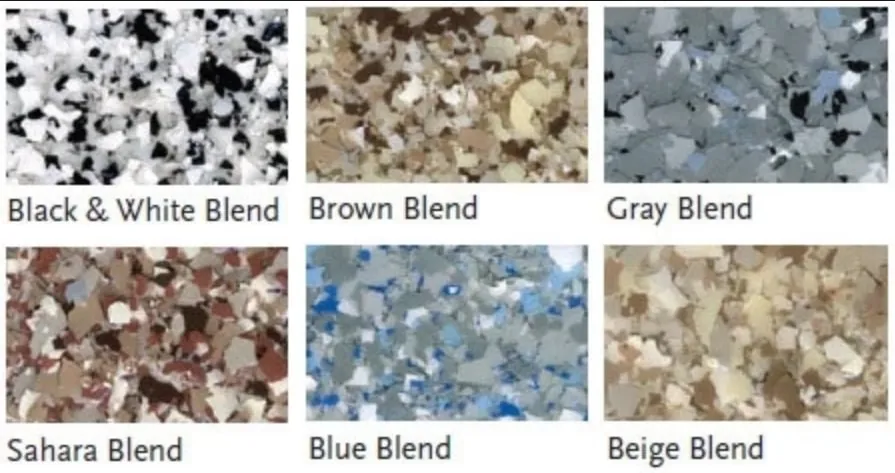
How Much Does Epoxy Flooring Cost in St. Petersburg? (2026 Guide)
Per-square-foot ranges by finish, and what a two-car bay totals.